DTD 233
===
Welcome to the Drive Time Debrief with The Whole Physician, a podcast to burnout-proof your medical career with candor, humor, and encouragement. You've spent tens of thousands of hours learning how to care for others, but now it's time to learn proven tools to care for yourself. If you're tired of feeling stuck, disillusioned, and exhausted, you're in the right place.
Start your journey to bring back contentment and purpose. Now, here are your hosts, three board-certified emergency physicians, Doctors Morrison, Cazier, and Dinsmore.
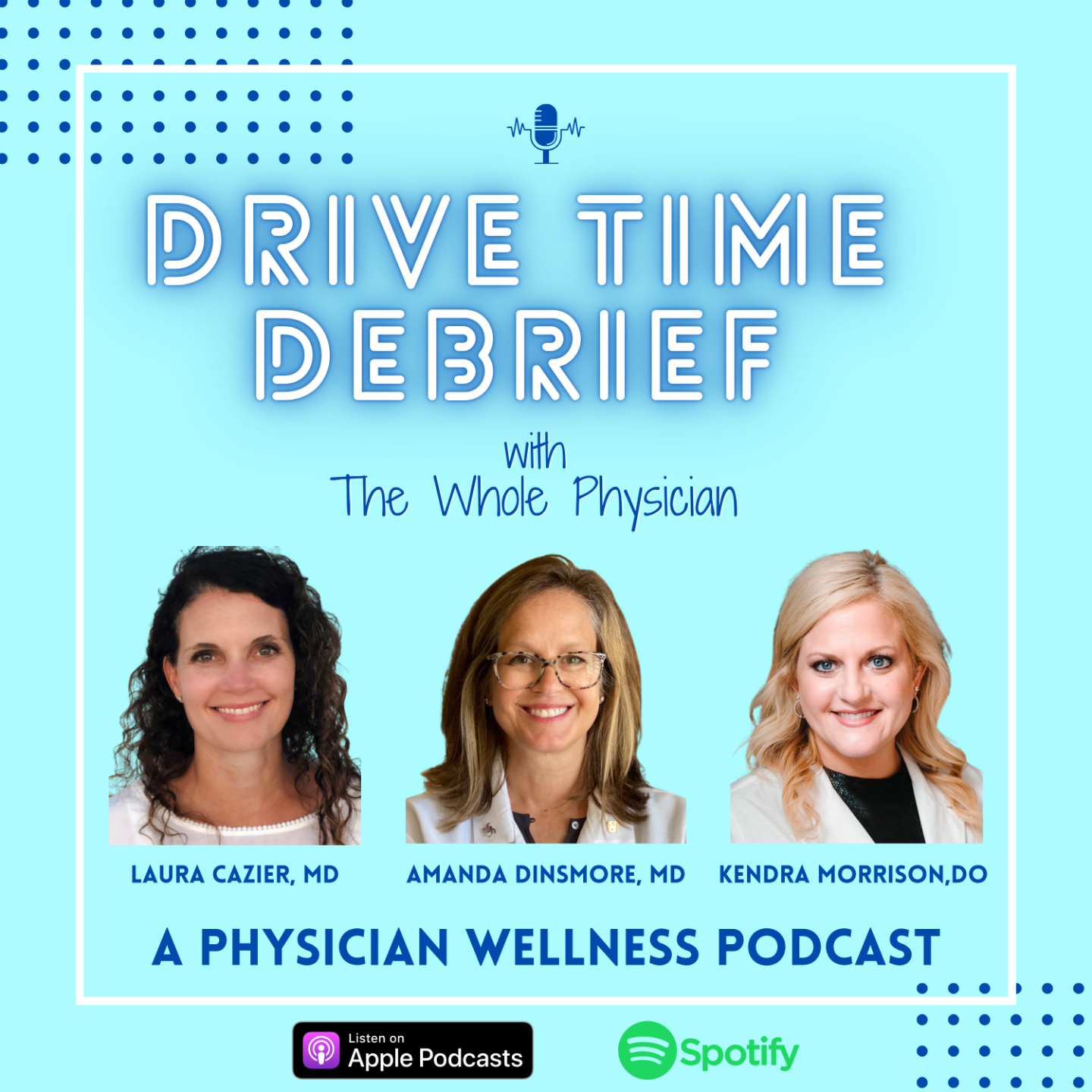
Hey, guys. Welcome back to Drive Time Debrief. I'm Amanda. I'm Laura. And I'm Kendra. And today we're gonna talk about the reputation trap—why the career you built is the same one boundaries will save. So picture the physician everyone in the hospital wants on their team. He answers pages at midnight, never says no to an extra patient at the end of clinic, covers for a colleague's vacation without blinking.
Every attending, every resident, every nurse would tell you the same thing about this person: rock solid, always there, my favorite, you can count on them. That's a reputation that took years to build, and it's quietly killing them. Welcome back to the podcast today, and we're talking about something that doesn't get named enough in medicine—the way our reputation, the very thing we've spent a decade or two building, becomes the reason we can't protect ourselves.
We're taught that boundaries will cost us that reputation, and we wanna make the case today that the opposite is true. Boundaries are what let the reputation survive. Yeah, I think this is a good conversation. I've had a couple of clients in their sessions recently feel that maybe there is—you know, it's almost like I visualize it as one of those rope-ladder bridges across a canyon, and it's like, one little bit heavy on this side and you're flipping right over.
It's not quite as fragile, I think, as we think. I think we make up a story about it, like, "Oh, it's too late to pivot. It's too late to build on my reputation. It's too late to change things now." Even if you're 15 years in, it's never too late. So we're myth-busting today. We're gonna bust the myths today.
And you know, somewhere between medical school and our first attending job, somewhere we learn—maybe we just made the story up, maybe we learned it from attendings, I don't know, it got there somehow—that reputation is a one-time achievement. And even if you don't even go and work—say you went to med school and rotated somewhere, then you did residency somewhere different, and then you moved again and worked somewhere different.
Like, this type of reputation, how you show up—and we talk about this a lot—is based on who you want to be. So you have an opportunity every shop you work in, every clinic you set up in, to be continuously building that reputation. And it's basically the part of you that you are consistently showing up as.
So the part of you that earns trust with your colleagues, the part of you that builds rapport with patients—it helps you get referrals, right? If you're a consultant or a specialist, your referral base is based largely on reputation, right? And you feel like at some point it's locked in, like you can't do anything about it.
And you know, while that may be true in a way, we just wanna invite you to maybe open your mind a little bit. It's more than just your credentials, it's more than your fellowship, and it's more than where you practice. If you aren't quite convinced, and you believe that you've locked in your reputation and that's it, every boundary you make can kinda feel like it's threatening that reputation.
And if the reputation is a fixed asset, then saying things like, "Ugh, I actually can't take that extra call this weekend, it's my daughter's birthday," or, "I can't stay late tonight, I actually have plans outside of the hospital," that can feel like it's actually chipping away at this fixed reputation that you might feel like you can't get back, or that it erodes some part of you that you're used to showing up as.
But that's not how it works. That's not how reputation works. Let me invite you to just stay with us here a minute. Really, it's not how reputation works in medicine or really anywhere else. Reputation isn't a plaque or a diploma or credentials—it's actually a practice. It's not something you built when you graduated in 2012, 2014, 2015, and now protect like it's a vintage museum piece, right?
Locked up in a clear glass case for no one to touch or see, or for everyone to see but not touch. It's something you're building right now, every day you choose to show up and do the work you do. It's in this week's patient encounters. It's how you talk to your team. It's how you show up even when you're tired.
It's every single day another brick, not a victory lap on the bricks you already laid. And so here's the part that we skip over. A reputation built entirely on availability without limits isn't actually a strong reputation. You may feel validated because people notice, and you feel that you are—what do I wanna say—you are reliable, you are... they can count on you, and... But if you are constantly building those bricks, they're actually built on a very fragile foundation, because the moment you can't sustain that pace—always saying yes, signing up for the extra shift, the extra call—eventually you're not gonna be able to.
That reputation will collapse as soon as you do. And so then colleagues don't necessarily remember you as reliable, they remember you as the person who crashed and burned. And I'm only speaking from personal experience—who left, or maybe had a total blanket moment, left, you know, with a finger held high, walking out in flames.
I don't know. But you just have a defining moment, and it might have been because you just came off a string of night shifts, or you took that extra shift and you knew you just couldn't handle it. So the version of your reputation you were trying to protect is exactly the version that boundaries would have preserved. Yeah.
So I would say that the biggest person you need to care about in terms of reputation is yourself. I think a lot of us operate in a way that we're very concerned with what other people think, and of course we want people to feel like we're reliable. That will only come if we're reliable for ourselves as well, if we're showing up for ourselves.
And if we don't, what Kendra just described eventually happens. If we're reliable for everyone else but are not taking care of ourselves, we'll flame out, and sometimes go out in a blaze of glory or a blaze of shame, depending on your perspective. Or a blaze of four-letter expletives. Yeah.
Yeah. So as we're talking about reputation, that's just something I wanna highlight—your reputation with yourself, with the ones you love, the people who are most important to you, that's gonna matter more than everyone else thinking you're reliable or such a team player at work.
So I'm gonna talk to you about a couple of different example physicians. We'll call them Dr. R and Dr. W. They have different specialties, trained in the same era, with the same instinct at the start of their careers, which was to say yes to everything. And many of us were told to say yes to everything and never be the doctor who can't.
So if that's programming you picked up, that's not a problem—just being aware of it. Dr. R built her early reputation the classic way: always covering, always available, always the one who'd pick up the extra consult, answer her pager after six o'clock, or whatever the extra mile was for her.
And for years at work, she was known as unshakable. But nothing about that reputation was designed to last, because by year eight—and probably before that—she was skipping meals, missing her kids' school events, and increasingly short and impatient with her staff, which was the opposite of the reputation she'd spent years building.
And the story that started circulating wasn't "she's so dependable." It became, "She's burning out," or, "What's wrong with her?" And it was being said by the same people who used to rely on her. The reputation didn't hold—it inverted. And why? Because she was not being reliable to herself and the things that mattered most to her.
Let's talk about Dr. W, who took a different path—not instant or comfortable, but different. Around year five, he started saying things out loud that felt risky at the time. "I'm not gonna take extra call anymore. I need twenty-four hours before I can turn around that pre-authorization letter. I'm gonna finish this visit properly rather than double-book to squeeze one more patient in."
And as he started saying these things, he expected pushback, and he got some, but something else happened as well—his staff, his colleagues, started describing him differently. Not as the guy who'll do anything, but as the guy whose yes actually means something because his no is real.
And the patients felt it too. He was less rushed, more present. The truth is, when we operate this way, we find that difficult patients sometimes find a different doctor to go to. When boundaries are present, things get better. His reputation didn't shrink when he set limits. It got more specific and trustworthy, because it was sustainable.
And the difference between these two doctors wasn't work ethic or skill—it was whether they understood that reputation is something they had to keep building, including the parts that required saying no. And remember, we always like to say: when we say yes to something, we're saying no to something else.
So when we say no to something, we have space to be able to say yes, or to be able to keep a previously made commitment. And so he realized that reputation is something to keep building—and that's not just with colleagues, but with ourselves as well. And the converse of that is that if we're not building it, we're taking it down, just spending down what we built up earlier in our career. That's so good.
So what does continually building your reputation look like?
If reputation is ongoing rather than one-time, then boundaries are not a departure from professionalism. They are one of the tools you can use to build it and, especially, to protect it. So a few examples of what that looks like in daily practice would be in how you communicate.
A physician who tells a patient clearly and kindly, "I'm not gonna prescribe that today, but here's what I can offer instead," is building reputation in that moment as somebody whose medicine is thoughtful, not just, you know, a drive-through McDonald's. It's not just reflexive. That's a brick. So another brick can be in how you protect your schedule.
Blocking time to actually finish notes instead of taking on one more add-on isn't laziness—it's a statement about the kind of care you intend to keep giving. Colleagues and patients notice the difference between when you're rushed and when you're rested. Even if they can't name it, that's a brick too.
And actually, some of our subsequent podcasts are gonna be on the difference between productivity from a busyness aspect and productivity from precision. Precision looks like this, where you're thoughtful and you do it once, but you do it well. That's kind of the same thing—when you have boundaries, you're able to do it once and do it well, and that's a totally different feeling.
So another brick can be in how you handle being wrong or overwhelmed. Telling a colleague, "I need a second opinion on this one," or, "I'm at capacity this week, can you take this next admission?" doesn't damage your standing. Over time, it builds a specific kind of trust—the trust that comes from knowing your limits and being honest about them instead of overextending yourself and hoping no one notices the cracks. Yeah.
Can I say, too, these two are interesting, because I also heard two excuses like, "I'm the only one who can do this procedure at this hospital, in this area," whatever. So about protecting your schedule—okay, that might be fact, that might be very true, but there is still a way, if it's non-emergent and you're not saving someone's life in the moment, to still protect your boundaries in your schedule, to still be very intentional about, okay, whatever I can fit in from 7 a.m. to 5 p.m. this day, or whatever it is.
So while you feel the urge in you to be like, "But I'm the only one," there is still an element of your patients appreciating a physician who knows their limits. You can only do five surgeries a day before you need to go to the bathroom and take a snack or whatever. They want you to show up and be on your game.
And the second one, about being overwhelmed—I also heard some pushback from a client, like, "Yeah, but they roll their eyes. My partner rolls their eyes or is nasty back to me." Well, you know what? It's probably because they don't have boundaries themselves, and that sneer, or that rolling of the eyes, or the big sigh, is because deep down they're like, "Wow, maybe I wish I could say that," you know?
And next time, maybe it won't be as hard. So those two, I feel, could get some pushback—I've already heard it. But I assure you, sometimes you have to be the bravest and most courageous to set one small boundary in your practice or your group, and then others notice.
It will be hard at first, but then they'll be like, "Wow, she can do it. Maybe I can do it." Yeah, that is interesting. When nobody treats themselves as a human being, it doesn't give permission to anyone else either. So sometimes you do have to be the first one to do something a little different.
I would offer that, given the burnout stats, the way we're currently doing things is not working. So potentially we should get creative. Creative. And maybe exercise a boundary. Uh-huh. I hear that too, a lot, with clients—like, "You don't understand, I'm in an underserved community and I'm the only person who can do whatever."
We're talking right now about how you're ready to resign. Yeah. So next week they're gonna have zero people. So maybe there's a middle ground where you can help some, you know? Boom. Yeah. Brains are just hilarious. They just get a belief and cling to it at the expense of— They tell stories,
what seems to be— Yeah, yes, tell a lot of stories. Very convincing. And I will say, if you've been living this way, there is a cognitive dissonance—it's uncomfortable to do something new. It'll also bring up some regret sometimes, like, "I should've been doing this all along," blah, blah, blah.
And I would offer that's not useful at all. But tomorrow is a new day, and you get to choose if you wanna keep doing it the same way or try it a little differently. Okay, so we're continuously building our reputation. The next way you might be able to do it is in how you show up whenever things are hard.
A hard boundary conversation with an office manager, a firm line with a demanding referral source, a no to a request that doesn't fit your scope—none of these are one-time events either. They're small, repeated deposits in the same account, the account that says, "This physician practices medicine on their own clear, honest terms."
None of this is a single defining moment. It's cumulative. So every week, you either add to that account or you're gradually withdrawing from it, either by overriding your own limits to protect an image that you think is already finished. And this conversation—we're talking a lot about boundaries and setting limits—it's not just about that.
It's really about burnout, and this idea of living without boundaries is such a huge driver of burnout. We come into medical school with poor boundaries, which is why we could accept all the crazy things we were told we had to do to become doctors. And then we got this fear of being labeled a bad doctor, or incompetent, or unreliable, or lazy.
And so that fear of damaging your reputation by setting a boundary is one of the most consistent and under-discussed drivers of physician burnout. Certainly workload is an issue, but it is rarely only the workload. It's that workload plus the story our brains tell us—that setting limits, going home on time, saying no to that prescription, is going to cause problems with our reputation, and that it will undo years of who we've become professionally.
And that belief keeps physicians drowning by themselves and feeling so alone. And this is why I know Amanda and Kendra would want to tell you: these issues are so common. We see this over and over again in our physician clients who are thinking they're on the verge of quitting or just completely unsure of how to keep going, and it's because they still believe they have to do all this crazy stuff to be a doctor.
And they're on the verge of quitting, and it's like, no, you actually have more choice in the way you're living your life and the way you're practicing than you think. And you can learn to say no. Certainly, early in our careers it might make more sense to say yes to things to build the career, but when we keep doing that on into when we have kids, and when we're tired, and when we're burned out and frankly about to quit—that becomes completely untenable.
And the doctors who last, the doctors who actually enjoy practicing medicine more than just a few years, are almost never the ones who never said no. They're the ones who figured out, maybe later than they wish they had, that boundaries are not subtracting from your reputation. If you think about the people you work with who do leave on time, the ones who are pretty clear about what's acceptable and what's not in their patient population—an easy example is, in emergency departments, patients will sometimes call if they want narcotics.
They will call and find out which doctors are working. Mm-hmm. And if it's a doctor who has held a boundary and said no, guess what—they don't waste their time coming in. And it's the same thing when we're saying yes to things we don't want, we're gonna get more of that thing. So let's figure out how not to do that.
Have some boundaries that will help us have a sustainable career, and they're not gonna give us a reputation as an incompetent doctor. When those drug-seekers call the ER, it's not that they think those doctors are incompetent—they just know the ones whose boundaries they can run over.
And so let's not be that kind of doctor. Let's be a doctor who acts out of principle, out of honesty, out of what we really feel good about offering to this career, so we don't feel like it's taking so much of the one precious life that we have.
Can I add something to that? This all sounds really good, but you're gonna have to ask yourself: are you relentlessly judging people who actually have boundaries? Mm-hmm. Because that's how I started—I was like, "Oh my God, I can't believe that. That person's not a team player. I would never."
Okay. When you're glamorizing self-sacrifice to the god of medicine, your brain, because of cognitive dissonance, is not gonna let you start exercising boundaries. So catch yourself. The next time somebody who has a healthy boundary comes up and you're like, "Oh my God, I can't believe that, I would never—kids these days, they don't understand how we had it,"
you know, all that sort of stuff that comes up—you are welcome to keep that, and you will never figure out how to have your own boundaries, because you are judging people so negatively who actually do have healthy boundaries. So what you're gonna need to start doing is seeing how this is such a smart thing.
Like, wow, those guys are so clever. They have the job and a complete life outside of medicine too. They have healthy marriages. Their kids know their name. You know what I mean? You're gonna have to notice what's going on in your subconscious, because there's probably an excellent reason why you're doing this, and it's showing up in your judgment of others, and that's probably why you won't let yourself start doing it either.
But if it's not working for you, that's actually what coaching is all about—looking at what's going on underneath the surface and changing it so you get the results you want, because this isn't working for most of us. Yeah, that's real good. I'm glad you brought that up.
Because—like we said, the examples we gave today, and the foundation of... we talk a lot about boundaries because it is essential. It is one of the main things that, underneath everything else, drives us to do things like leave. If you peel back all the struggles, starting somewhere with creating one tiny boundary and just seeing what relief you may feel, or whatever the goal of that boundary was, actually feeling that and noticing it, and you're like, "Oh wow, that was easy," you know?
And also, on the other hand, being able to—the idea of continuously building the reputation. So it's not a one-and-done thing. It is not that bridge where if you put too much weight on one side or the other, you're flipping over. It is a lot less fragile than that, and you can continuously build it. So this week, just think of one area, maybe a small boundary.
Maybe this has brought something to the front of your beautiful brain that's like, "Oh, that's what that is. That's a boundary. That's what I need to do." And you've been afraid because you're concerned with how those people might think of you, whether it's your group, your colleagues, or maybe the nursing staff, or your office manager, or your OR crew.
Whatever it is, just think about it. And if it is nudging you, then it may be an area where you need to be brave enough to just start and set that boundary, because saying yes is creating resentment, or it's creating something in you that is not creating peace, or it's not gonna create a sustainable career.
And then once you notice it, ask yourself this question: is protecting that old version of my reputation actually protecting my reputation, or is it just delaying the version of me that eventually burns out, quits, goes out in flames with middle fingers high? I don't know. But just think about it, okay?
And then, if you're ready, just set that one boundary. Just start small. Don't see it as risky behavior—see it as planting or building a brick in the foundation, and notice what might happen. It might be uncomfortable, but notice what happens. Notice that maybe it doesn't turn out like you thought.
Maybe the biggest fear that you thought—the catastrophizing your brain is going to do—actually isn't gonna happen, and notice what actually happens. So that's it for today, friends. Thank you for joining us. We hope you found this conversation helpful, and the best way to support us is to subscribe, so click that button now and leave us a rating and review—five stars, of course—because it helps other physicians find us and moves us up on the list.
And if you do leave a review, take a quick screenshot and send it to [email protected], and we will send you a free e-book on emotional regulation, which is actually one of our most requested and impactful topics. And before you go, we have a gift that we've curated just for you. We've created a Podcast Fast Track because, as you know, we've been doing this for a while, and we have well over 200 episodes, which can be kind of overwhelming if this is the first one you're listening to.
So we've handpicked a collection of our most high-yield episodes designed to help you jumpstart your journey to freedom from burnout. So head on over to www.thewholephysician.com/fast-track
to discover your personalized path to wholeness and healing, and we'll include that link in the show notes. So thank you for spending time with us today, and until next time, you are whole, you are a gift to medicine, and the work you do matters.
Thank you for joining us for the Drive Time Debrief. If this podcast has helped you, be sure to share it with others. Please subscribe and leave us a five-star review so other doctors can find us. If you want to know more about what we do or work with us, go to our website at thewholephysician.com and schedule a free 30-minute strategy session.
We'd love to help you create the life you dreamed of before things went awry. It's absolutely possible.