# Emotional Intelligence Series - Part 1: Self-Awareness
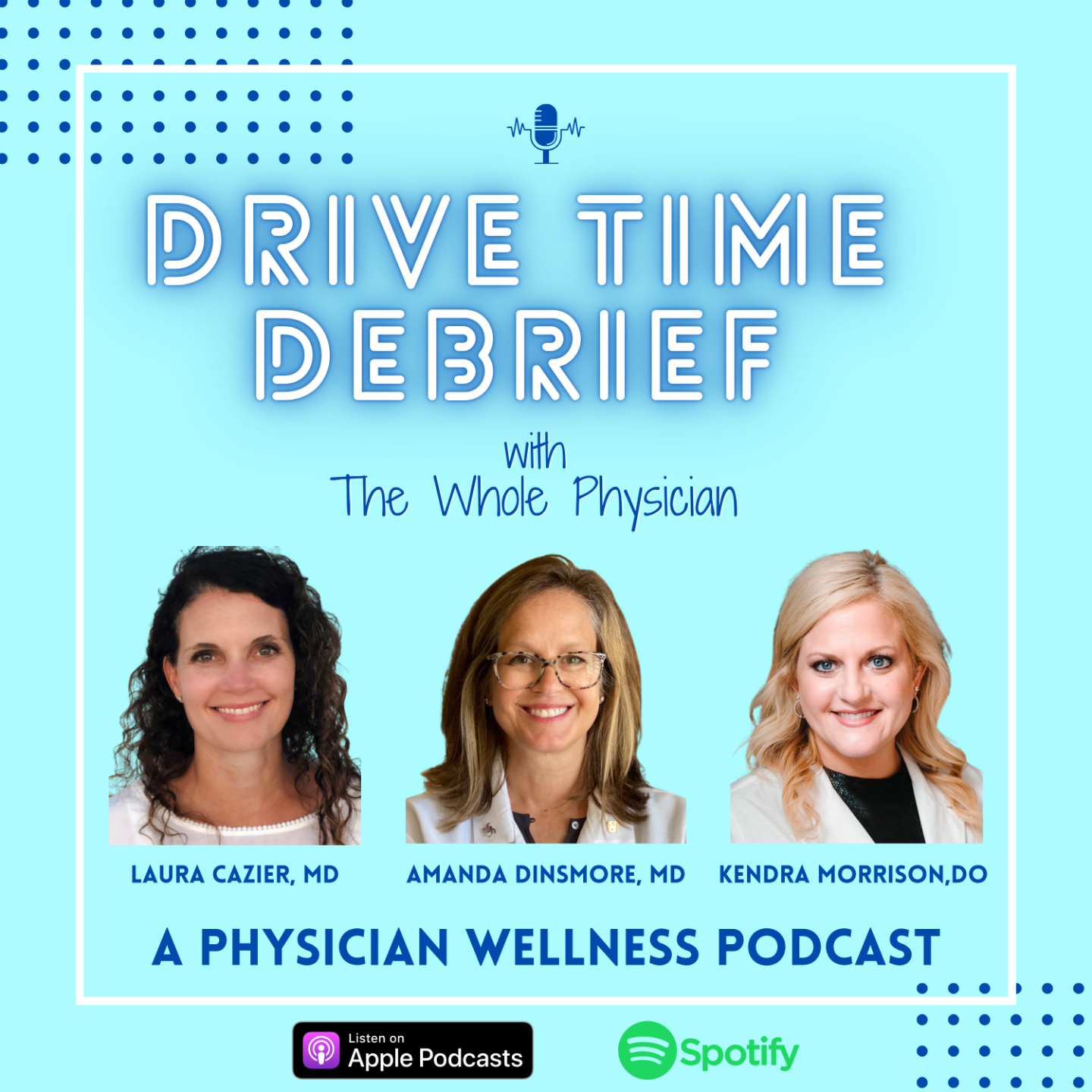
Welcome back to the podcast. I'm Amanda. I'm Laura. And I'm Kendra.
Want to once again, thank Doctors Podcast Network for awarding us the best podcast for physician wellness and burnout. That was such an honor, and please go to their Facebook page, Doctor Podcast Network. There's so many physician podcasts that you should be checking out. We're just one of many and they're all fantastic. So just a little plug for that.
So we are gonna start a series, a multi-episode series on emotional intelligence. And that is because it has been shown that our medical training sometimes makes us intellectually intelligent, but sometimes less emotionally intelligent. I do remember part of my career where I felt like it was very much the more robot-like we were, the more I could bounce from one patient to the next patient and still get five stars, but like not have an emotional breakdown myself, you know, was definitely rewarded. So I was just shoving stuff. Yes, exactly. Exactly.
Also, you may notice that in business and industry, in life in general, the people who have more emotional intelligence sometimes are far more successful than those who are intellectually intelligent. And I'm not saying that that's what's happening where you work, but you might notice that in some places where you work that maybe the C student is actually running the show and you're just there grinding away. Wherever you work, many times it's because they are emotionally intelligent. This is not taught in med school.
So let's start with self-awareness. This is gonna be episode number one of this series. You cannot regulate what you don't notice. So if you've ever said, "I'm fine" and then found yourself snapping at someone you love later that day—ouch, shots fired. Yeah, so this is the foundational skill for emotional intelligence. Not because it's trendy, not because it's therapeutic, but because it's practical.
And so here's the core idea to keep in mind as you listen: you cannot regulate what you don't notice, and many physicians are exceptionally good at functioning and keeping their head down and powering through while being surprisingly disconnected from what's happening internally. The first time somebody in coaching asked me, "How do you feel?" I kept saying over and over, "Well, I think that this is stupid." Or like, "I thought that this was a fantastic result." That's not a feeling, that's not an emotion. I'm still in my head thinking, and a lot of us physician coaches like to joke that we're cut off at the neck. We're just floating brains going around. We never do drop into our body and feel something. I had a new client last week who was like, "What do you mean? Where do I feel that?" I mean, there are so many days at work that I wouldn't even go to the bathroom. Mm-hmm.
That's not right. That's not normal. Mm-hmm. Override your fatigue, override your hunger or override your emotion, override your fear. Mm-hmm. In the service of the task, in the service of the system, the patient, everything, that ability can save lives for sure, but when it becomes the default mode everywhere in your life, it will quietly fuel burnout, resentment, emotional leakage into everything else, disconnection, especially at home. It also leads to episodes when you're in your closet changing, minding your business, and all of a sudden a memory will pop up and you're just like, then you process it and it's like, "Where did that come from?" Mm-hmm. Oh, it's because you shoved it down 15 years ago. Good. Mm-hmm. Good. Seems, seems healthy, and there's just effervescence to the top. Congratulations. Yeah. Yeah.
Then again, I told a friend about that one time, a non-medical friend, like, "Oh yeah, I was just standing in my closet and this memory from like, whatever." She's like, "Have you gotten therapy for those?" Like, "No. What do you mean? No, it just came." Mm-hmm. Okay, so let's stop doing that.
Today we're gonna talk about what self-awareness actually is and what it isn't. How low self-awareness shows up specifically in physicians, and a few simple, usable tools that you can apply immediately, even on shift. So no therapy language required. That's good 'cause I'm not going anyway, at least the previous version of myself. No journaling required. Just awareness that actually works in real doctor life.
What brought this to mind for me was one of my daughter's friends sent me a post that she'd seen on, I think TikTok that a medical student said that she felt like medical school was making her evil and apathetic, and I was like, "You are not wrong. There's something happening. You're right." It is making you less emotionally intelligent unless you are being intentional in the development of your emotional intelligence, because guess what? Lots of your attendings have very low EQs, and may or may not value that. We're trying to change that and are seeing some thawing of the ice in some places, and are hopeful that when the EQ level of medicine is raised, that we'll all work in more pleasant places.
For somebody who's never heard of EQ, will you explain what that is? So the idea of emotional intelligence was, I believe it was Daniel Goleman, who is a psychologist who—I don't know how long ago, it was probably 20 years ago now. I think he wrote a book called Emotional Intelligence and brought these concepts to greater awareness because in the past, what has been rewarded is what has produced, you know, we're products of a post-industrial revolution era. And during the Industrial Revolution, feelings did not matter. If you think even generations further beyond that, people couldn't even really get that attached to their kids because so many of their children would die of childhood illnesses.
But we are coming into an era where emotional connection with other people is what creates meaning in life. What is the most rewarding? It's not producing things. It's not money. It's not financial success. It is emotional connection. And so emotional intelligence is the set of skills that helps us identify emotion in ourselves, learn to regulate it in ourselves so we're not freaking out, out of our control, we're able to calm ourselves down. We're actually able to notice the emotions in other people and help other people regulate their emotions as well. It's a very, very helpful set of skills that if we have no idea what our own feelings are, we have zero chance of being able to help calm a room down in a real sustainable way.
So those are the basics of what emotional intelligence is and why we want to have it, and so they call it EQ, kind of like we call IQ—Intelligence Quotient. EQ is your Emotional Quotient, I guess. Yes. Yes. Is that fair? That is my understanding, yes.
And the first key is this self-awareness. And so we're gonna talk about what we mean by that. This term can get misunderstood. It's not overanalyzing yourself or being emotional all the time. It's definitely not losing control. And this is true of all these skills—these are going to make us more effective in work and interpersonal arenas. If we have kids, oh my goodness, this is such a helpful set of skills to have just in life, and it will help improve our quality of life too.
It's the ability to notice what you're feeling, what you're thinking, and what's happening in your body in real time without immediately fixing it, suppressing it, or explaining it away. So you can see how this was kind of trained out of us. I'm gonna repeat this—what self-awareness is, again, one more time. It's the ability to notice what you're feeling, what you're thinking, and what's happening in your body in real time without immediately fixing, suppressing, or explaining it away. So noticing doesn't mean we're processing things, it's just being aware. It's not going and wallowing in the closet with a box of chocolates or something. It's just being aware and when we are aware of things, then we can manage them.
So to contrast EQ or emotional intelligence versus personality versus insight: Personality is kind of how we're wired. We might be introverted, we might be more decisive. We might be more empathetic or detail oriented. I heard the other day that there's something like 17,000 genetic traits that can equate to personality traits. So a lot of things are genetically encoded in us, and we can work with our own genetic blueprint to maximize our emotional intelligence. There are some people, and once you know this, you'll look around your hospital and be able to tell—there are some people who are wired for dominance and low empathy. These often are attributed to a narcissistic personality style. Those people are wired in such a way that emotional intelligence in the full spectrum of it is going to be more challenging for them. Now, they definitely can pick up enough to be manipulative. In terms of having compassion and empathy it's gonna be more difficult. So we all have this kind of genetic wiring and our family of origin contributes to this too. But we can work with what we've got if we choose.
Insight is understanding why you're that way. Whether you were born this way, maybe you have a long line of introverts behind you, maybe you have a long line of people wired for dominance. Then you look at your upbringing, your training, and what coping strategies you developed not only in training, but maybe in your family of origin.
And then self-awareness is noticing what's happening right now. What sensations are you having in your body? What thoughts are going through your mind? How are those developing emotions and what are the emotions you're having? You can be insightful and still not self-aware in the moment—many physicians are. You can understand your patterns intellectually and still override internal signals that you're having automatically.
And why do we do this? Why are physicians often high functioning, but low awareness? Because we're trained to be that way. We're probably trained to be that way in our homes as children. Definitely in training. We are trained to push through discomfort—nothing wrong with that to a point, right? When it becomes a way of life, it becomes questionable. Delay our bodily needs. Suppress emotion. Prioritize external data over our internal experience. It's interesting, like I would be curious to know how many of us really notice what emotions, feelings, sensations we're having during a day at work? We could tell you all the data we processed. No problem. Can we tell you what was going on in ourselves? Probably not. Most of us could not, and that is adaptive in emergencies when there's a real life or death situation happening. But over time, it trains our nervous system to ignore its own signals to where we literally cannot. We're like Amanda and Kendra just described. We cannot tell you what we're feeling.
This is a condition called alexithymia. It is basically feeling blindness, and that is what we train our nervous systems to do. And then you don't notice stress until it spills out sideways. You don't notice resentment until you are filled with blinding hatred. And as Amanda says, you do the angry Care Bear stare at the people expecting things to happen. You don't notice burnout until it's so loud you can't carry on. You are still competent, you're still productive. You become very, very disconnected from yourself and from other people. And so high functioning does not mean we are well regulated. It just means we're really good at shoving things down.
And there are two common myths that keep doctors stuck in this situation. Number one is "I don't have time to feel" or like, "Why is that even a thing? Why do we have to talk about that?" Feelings don't feel safe to doctors a lot of times, and here's the irony, is that unnoticed emotions end up taking more time than noticed ones. They show up as rumination over charting, irritability, avoidance, exhaustion. Becoming aware doesn't slow you down. It actually is the opposite because all that unprocessed emotion is gonna slow us down.
Myth number two, "If I become more aware, I'll fall apart or be less effective." This was one I was afraid of. Like if I let anything come up, it's gonna be like Mount Vesuvius, like I'm gonna have a complete come apart if I let anything out. And I will say the first time you go to therapy or coaching, that might be true. You might have one or two sessions where you just have to have verbal diarrhea of all the crap and get it out. That doesn't last long though. Getting it out, looking at it, processing it does not intensify the emotion. It shortens its half-life and helps it have less power over us. When we can name what's happening, we're actually recruiting blood flow up out of the limbic system, out of our emotional brain into the thinking part of our brain, and it helps our nervous system calm down. When we are avoiding emotion, it keeps those emotions active longer. And that is because there's part of our brain that actually is pretty insistent that it wants the stuff taken care of—it thinks emotions are very important and it's gonna keep harassing you until you deal with them.
One of my daughter's psychology professors shared this analogy, and I love it: Emotions that we shove down into the basement of our souls, they just go down there and lift weights and get stronger. So maybe don't do that.
Medicine rewards the suppression, rewards not noticing. Makes sure we don't have time. If you don't have time to pee or eat, you're definitely not gonna have time to notice the grief you feel over that cancer diagnosis you just had to deliver. And this is by design. We're kind of still in the industrial revolution model in medicine where efficiency is promoted and we are expected to not slow down and be human and feel. Medicine—stoicism, endurance, control, powering through. It does not reward pausing, checking in and naming our internal experience. So if self-awareness feels unfamiliar or awkward, that's no surprise. You were trained that way. You probably were wired that way a little bit and then went into an environment that reinforced it. It really is occupational conditioning.
Yeah. So let's go into a little bit of how low self-awareness shows up in doctors. This is where, I'll just give a couple scenarios. I'm not really trying to create a triggering initiative here on this podcast, but just notice. Just notice.
So case one, fine at work, but irritable at home, right? It's the Jekyll and Hyde. So let's describe a case, Dr. A—that's on the podcast here. No, just kidding. Is calm and respected, efficient at work, handles chaos beautifully, and at home she snaps at her partner, feels annoyed by small things and has zero patience by the time she gets home or as the evening carries on. She says, "I don't know why I am like this. I'm fine all day," but she's actually not fine. She's just unaware. She's been absorbing stress, suppressing emotion and running on adrenaline and caffeine, definitely, and her nervous system finally discharges where it feels safest.
This is so common, and we talk to clients a lot about this. This is not a personality flaw. This is not saying there's something wrong with you. It's just the unprocessed stress. And when you get home, when you kind of pull your car into the driveway or where you feel most familiar, it can trigger some things. So we talk about this a lot.
Chronic yes-saying—saying yes. And we have used this comparison a lot—if you are saying yes all the time and either not checking in with yourself or just saying yes out of habit, you're saying no to some things just by default. And what does that do? Well, that no could be a night that you need to rest and recover. And what will that end up breeding out of that is full-on resentment, right? The low self-awareness is allowing you to say yes automatically without checking in with yourself, and without checking in with the situation. We talked about helper identity and how sometimes we just automatically say yes because we have this identity built around the fact that we're helpers. And so we agree before we check in, and then you realize later, "Why did I say yes to that? Why did I pick up that extra call or that extra shift? Why did I say I would go round for my partner so that they could get out of here early today?" And what happens? Yeah, a lot of resentment builds. And then you're confused. You wanted to be a helper. Why is all this resentment building? Well, the missing step was that awareness, was that pausing and checking in before you say yes.
And this emotional numbing, sometimes it doesn't show up as the outright irritability. Sometimes it shows up as numbing. Some physicians don't feel irritable at all. They feel flat, they absolutely feel nothing. It's a shutdown mode, right? You're on full autopilot. Work feels mechanical. Life feels muted. Joy—what is joy? It's so distant. You don't even know what that means. And I'm not trying to paint a picture of clinical depression here. It's just that numbing. It's the thing that you've adapted over time to survive. And you can't just selectively numb pain or hurt or dismay or disappointment without also numbing the meaning. And so this can show up in physicians a lot of time—they're just so flat and so disconnected.
And then there's the over-identifying with competence, right? This is another sign of that low self-awareness. You only feel okay when you're performing well and that's dangerous because guess what? On the flip side of that, mistakes feel devastating. Criticism, you take ultra personally and rest, let's not even talk about rest 'cause you need to deserve it, right? You need an excuse to rest, right? It's uncomfortable to even need rest. And your identity now has fused with competence. And without awareness, your worth becomes conditional. And we're just trying to bring some awareness, but we do fall into the trap that our worth is based on production, and we're just here to shed a little bit of light on that.
The next one is the early burnout signals that doctors miss. Why? Because we're so resilient and burnout often creeps in pretty insidiously and it gets overlooked, right? We talk about this a lot, how our pain points—if we were to like mention them to other people, they would look at us like, "Are you kidding me?" But we let them get so advanced and so far down the road before we pull the trigger on anything that it is a wonder, right, that we survive this situation. And it's not just about the irritability, the fact that we're completely cynical, we've totally lost curiosity. We don't even wanna do small tasks. It's that overall feeling of trapped, but we don't have the language for it.
So we always love to give you some practical tools with these episodes. So it's like, "Hey, you've got a big problem," but we also wanna give you some tools that you can start addressing things with. So, and we wanna welcome you to the family. Don't worry about—that's good, Ebenezer. Exactly. That's our least favorite. Whenever there's like an article about burnout, it's like "Everybody's miserable. The end." Like, "Okay, great. Yeah, well, I guess we're doomed." No, that's not the message. This is gonna be, yeah, it's not this kind of awareness podcast. Mm-hmm. When we see those kinds of articles, like this was an opportunity, anywho. Okay, back to this episode.
All right. So practical tools for physicians. Let's get concrete. Let's start. What can we do? First one is, "name it to tame it," Dr. edition. Emotional granularity is that ability to name what's going on in your body, what are you feeling? And it does not sound like what I used to say of, "Well, I think that's just crap." That's not a feeling.
So this doesn't necessarily mean emotional processing, we're just trying to label what's happening to you. Tony Robbins over the weekend had a free training and he was talking about the framework he uses in like arguments with the significant other, because that can be an emotionally charged thing. And he uses something called the SEW technique, S-E-W that was originally developed by Dr. Julia Colwell, C-O-L-W-E-L-L.
So S is sensations. We do this with negative emotions all the time. Like you feel the tension in your shoulders. You feel like your face flushing, that burning behind your eyes, the pressure—that's the sensation. What's the emotion that goes with it? What I'm just describing is like, I'm embarrassed. Like I get this thing. So, S is sensation. There are things that your body is telling you. E is emotion. What emotion is associated with it. It might be, "I'm frustrated, I'm anxious, I'm disappointed." And then that tells you like, okay, I felt the sensation. Here's the emotion. The last part of SEW is W—what do you want? How many times we're upset about something, we don't even know how to fix it. How can we expect somebody else to fix it? How can we expect our system to fix it when we don't even know? So anyway, that's just a useful tool, but yeah, be able to label what's going on in your body, not just your brain, in your body.
Research consistently shows that naming the emotion reduces the physiological arousal associated with it. You're not indulging anything. This is how you regulate your emotion.
Brené Brown in her Atlas of the Heart book said when she started researching emotions and categorizing them, most people had three words for how they felt. Mad, sad, glad—that's it. So emotional granularity means like you just can more precisely name what you're feeling. Are you irritated? Are you angry? Or are you in a full blown rage? Those are three different things. Those are three different flavors. "Stressed" is vague. "Fine," like, come on, what are you even talking about? "Tired" is vague. Your nervous system will be able to respond better if you are a little more precise with that.
And so let's talk about the feelings wheel, which for sure I had never heard of in my life until coaching. But think of a feelings wheel. There's a website I think is www.feelingswheel.com. Just go there. Yeah, just go there now. Go there. But don't freak out. Yeah, just, just go there. Just look at it. The complexity, look at all of the choices. Are you really angry or are you more disappointed? Are you really fine or does that mean content or does that mean neutral? Or does that mean numb? Like what does fine mean? I don't know what that means.
So the center of the feelings wheel—this is a menu, right? The center has broad categories like anger, fear, sadness. As you go out towards the outer layers, it gets more specific, like irritated. We're talking about anger—irritated, resentful, discouraged, powerless. You don't need to memorize it, you don't need to journal about it, just use it when it's harder for you to tell what emotion it is that you are feeling.
Instead of saying, "I'm stressed," you might land on, "I'm resentful because I said yes when I meant to say no." That's good information actually. "I'm anxious because I felt out of control. I'm discouraged because I worked hard and it didn't seem like it mattered." That specificity shortens the emotional loop.
So think about a shift that you can't let go. Maybe you had a rough patient interaction, not necessarily even a bad outcome, no complaint, but hours later you're still ruminating on it. It's still replaying in your mind over and over and over. So without that awareness, this can keep going on—ruminating over charting, like trying to CYA about the patient encounter, being edgy with your family when your family had nothing to do with that. You know, I've had to say that to my kid so many times. "It's not you. I'm stuck in my head about this thing and I'm sorry that I was short about it." But with awareness you can say "I felt powerless and I'm telling myself I should have handled it better." Naming it alone often quiets it. It also gives you awareness where you can start to be compassionate with yourself. "Oh yeah, this is a rough time."
So one daily awareness question that you can ask is, "What am I feeling? What am I telling myself about the circumstances happening to me? What's the story I'm giving to it?" And whatever it is, it separates the emotion from the actual story.
Yeah, that's really good. That two minutes can be powerful and even maybe it will take more than two minutes. I started to be aware that my commute, which is sometimes 40 to 45 minutes, was the time that I actually needed when I did start to become aware, because in that drive home, I was able to nurture myself a little bit like, "I'm feeling something. I'm not really sure what it is. Maybe I just need food, but maybe I also need to process something." And so I just started asking better questions. We have a whole podcast on that. You can check it out. But asking better questions is just like, "Hey, what is possible here? What's happening? What's going on? What am I feeling?" And I was able to name it and be like, "Oh, I can deal with being dismayed or disappointed or bored even." Right?
Like we are high functioning, high achievers—bored can sometimes frustrate us, right? And so maybe that's all you need to say is like, "Give me a few more words and use them and just see how they land." And self-awareness, we're not turning all of us into emotional beings that are like sappy and full of words all day or like processing. This is not that. This is the awareness and it's more or less about being accurate with what is actually going on, and I will tell you it'll take practice. This isn't something you turn on today or tomorrow. It is something that is already valued by us as physicians, but that we just need to practice and notice a little bit more.
That's the beginning of emotional intelligence. So thanks for joining us today, friends. If you found this conversation helpful, the best way to support us is click that subscribe button now and rate us and leave a review because that helps other physicians find this podcast and we'd love to hear from you. So if you've had an experience or you're starting to notice and name, give us a shout. Email us at [email protected] and don't forget to follow us on the socials. We put a lot of great content. You can find us @TheWholePhysician and we love connecting with you there.
And if you'd like our weekly newsletter, we have The Weekly Well Check. It is bits of encouragement delivered straight to your inbox and plus all the details that we have about upcoming retreats, masterclasses, et cetera. So click the link in the show notes to sign up.
Thanks for spending time with us today. Until next time, you are whole. You are a gift to medicine and the work you do matters.