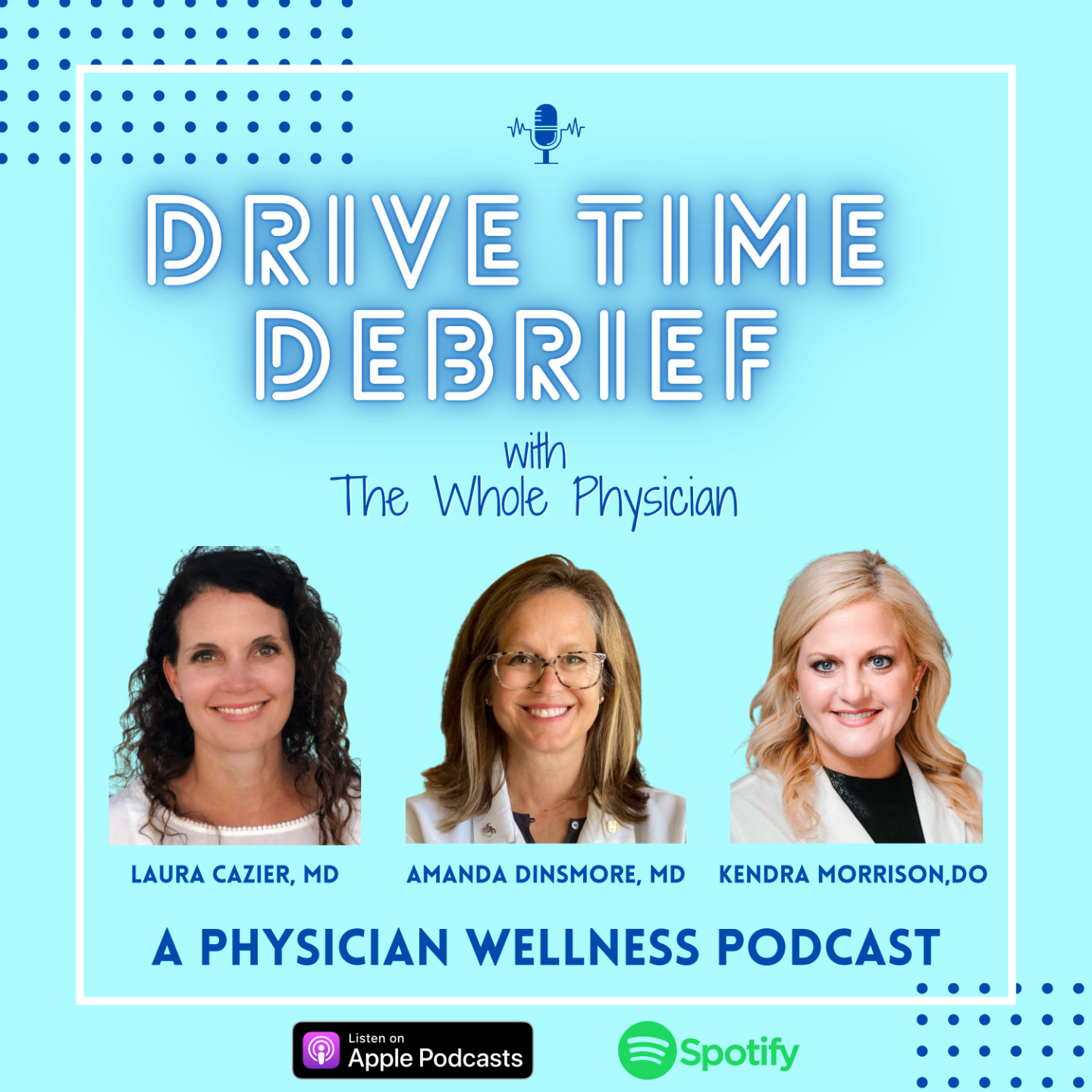
Welcome to the Drive Time Debrief with the Whole Physician, a podcast to burnout-proof your medical career with candor, humor, and encouragement. You spent tens of thousands of hours learning how to care for others, but now it's time to learn proven tools to care for yourself. If you're tired of feeling stuck, disillusioned, and exhausted, you're in the right place.
Start your journey to bring back contentment and purpose- Now, here are your hosts, three board-certified emergency physicians, Doctors Morrison, Kazier, and Dinsmore
Hey, guys. Welcome back to the podcast. I'm Amanda. I'm Laura. And I'm Kendra. And today you are in for a treat. We have a special guest. Dr. Mary Markham is a medical oncologist at Moffitt Cancer Center, specializing in gynecologic cancers. She has a particular focus on ovarian cancer and cancer survivorship.
She spent over a decade at the University of Florida, where she was most recently the chief of the Division of Hematology and Oncology and a professor. Her r- research centers on improving how care is delivered. It also focuses on patient-clinician communication, survivorship, and quality of life. But it's her nearly 20 years sitting with patients at the end of life paired with her work as founder of M Markham Travel that gives her an unusual vantage point on time, rest, and the cost of deferring both.
Thank you so much for joining us, Dr. Markham. Oh, thank you so much for having me. I'm happy to be here. You've spent nearly 20 years sitting with patients who are facing death. What have they taught you about time that you wish every physician understood years earlier?
Yeah, I've practiced oncology since 2008 when I finished my hemonc fellowship, and I think the longer that I've done it, the more I have appreciated how short life is. And I think we all as physicians have that understanding, right? We're all familiar with the, the tragic diagnoses that happen, but I, I probably spend an inordinate amount of time thinking about those last years, weeks, months, whatever they may be.
The thing that sort of struck me has or has struck me over and over again, but especially during the pandemic when, when we were all you know, stuck at home, but when my patients had lost really the ability to take their last trips, was just that, that pervasive feeling of regret that so many of my patients shared with me.
Not about all the work they didn't do, but really about that life that they postponed. And much of it actually centered on spending time with family, with friends, and doing so through travel and through getting out of their day-to-day environment, and that continues to be a theme. I, I practice still, and it's, it's something that comes up nearly every clinic session for me Yeah, that's a good point.
We hear that a lot. There's, there's definitely a theme, and I think it's because, and you can weigh in on this, but, you know, when you leave your day-to-day and you, like, go somewhere else with the people that you love, like, that's quality time. That... You're there, you're in- experiencing the travel together or the, or the new environment together.
There's not anybody else to pull you one way or the other, and it seems like a great use of, like, a, either a short or long amount of time, but very quality. Well, I think that that's it. You know, when we, when we do get away whether it's by ourselves or with family and friends you know, the expectations to do all of the things, the chores, and the, the sort of the day-to-day running of our lives, it's put on the side burner and we can really just focus on, on having fun and relaxing or, or doing nothing and reading a book.
And I think that that you know, people, we all are guilty of this we, we typically put ourselves last. A- and especially as women. I, you know, I'm biased 'cause I treat only women with, with cancer. But I think women in particular are really bad about prioritizing themselves. We prioritize our, our work, our family maybe not even our friends actually, but we definitely don't prioritize ourselves.
And I, I've seen that in patients, and I've seen it in my colleagues and in my, my friends, and when I was a division chief I saw it in the faculty. It's just it's a, it's a problem that we have in this sort of day and age of our busy lifestyles. Yeah. Why do you think that is? You know, I don't know. I think, I do think there's a cultural difference when I compare...
When I talk to people who are in other countries, and I just got back from Italy, and, you know, learning the, the way of life in Italy is very different than the United States. And so I- it is really in our nature as United States citizens, and maybe even in, in North America in general, but certainly in our, our sort of Western environment where work is really the priority and being productive, like being productive is the goal, right?
So, it, it's it's cultural and I think just, you know, being women we're, we're sort of born with a to-do list in our brain I think. Yeah, we've talked about that. Yeah Yeah. B- that we turn into human doings instead of human beings, for sure. A- absolutely. I love that, that phrasing too.
I mean, I think that's, that's exactly what it is. Yeah, and I think, you know, that's such a good point, 'cause I was in Spain earlier this summer, and it was interesting to immerse yourself in that culture of, I mean, seeing ver- I mean, tons of successful businesses and companies, and yet they're open 9:00 to 1:00, and then again, like, maybe 3:00 to 5:00 or something like that.
Like, like, it was just a whole thing about, "Oh, no, we have to go home, have lunch with the family, rest, then we'll be back," or, you know, just different nuance. But it was ... Like, even though we tried to see as much as we could, it wasn't busied. Mm-hmm. Like, we took our time, and, and, you know, there was plenty to do, but it just didn't seem hurried.
There was no rush around us either. So it was interesting to really experience that. It's a different perspective. And, and honestly, I think that that's one of the benefits of travel, is that we do get to actually see how other people live their life, and it's, it's really very different in many, many other countries from the way that we live it here.
I mean, I think their priorities, and we all know this priorities around, you know, women taking time off for caring for a child or an aging parent. The societal norms in other countries are just very different than they are in the United States, and so we ... I- it becomes ingrained in us. We see our parents do it.
We see our siblings and our other family members and friends sort of lead this just very busy, focused, productive, goal-oriented life really to the detriment of our general wellbeing as, as, as humans. Yeah, that's a good point. And so when we talk about this rest and going away- ... to be restored and maybe even reconnecting with our family or the people that we surround ourselves, our loved ones, and you talk about them that they're, it, that's not really an indulgence.
It's actually probably more like a clinical necessity. Can you elaborate on that? Yeah, and I, I, you know, I have not dug into the research on this, but just knowing seeing the levels of burnout that I have seen and that I think is just rampant in healthcare right now, in medicine in, among physicians in particular, but not exclusive it, it, the burnout rate is very high.
And it is not good for our, our health in general and certainly our mental health, our physical and our mental health, I think, to not actually make time to rest. One of the things that I notice, I'll just give you this example, is when I take time away, whether it's a domestic, you know, long weekend away or an international trip or, or honestly just like an hour walking my dog with nothing happening except me and the trees and the wind and my dog sniffing at lizards, I mean, that time actually allows us to become more centered and grounded and, I think, understand what's happening in our own bodies.
And so I'm a huge believer that we have to make that time, whatever that looks like even in small little micro moments, to reconnect and center ourselves and actually listen and be mindful and tune out the noise. So it's, it's just something I'm very passionate about. In fact, I I know that women physicians are terribly bad at this.
So one of the things that I started doing is when I created my, my travel company, one of the, the things that I do annually now is I do a, I host a long weekend away at a wellness spa at Miraval, at one of the Miraval properties- Mm-hmm. Yes ... for women physicians, and it's fabulous because that is the goal, is to actually do nothing except be indulgent with our own selves, right?
Our, our mind, our body, whatever. I, in fact, I often get the question, do I ev- do I have CME for these experiences? I'm like, "No. Definitely no CME," because the point is not to work. It's to actually get away from it. So not having CME is actually one of my favorite things ever. this idea of that rest, restoration, reconnection are things that physicians need I understand this is what led you, was part of what led you to found Markham, M- M- Markham Travel.
What do you actually do there? And you've talked about that a little bit, which a Miraval retreat sounds incredible. What made you wanna build it in the first place? So, probably my own burnout actually, except I didn't know that I was burned out. I always, throughout my career, I've always had some kind of a creative outlet.
And in hindsight, and this, the hindsight happened during the pandemic I realized that travel and planning travel had actually been part of that creative outlet for me. I would have obviously planned for my own personal trips, but, you know, talking about planning with friends and helping them to create their itineraries was always something that I engaged in but didn't really realize it until the pandemic happened and all of that stopped.
So when the pandemic happened, I realized sort of, I mean, two things became clear. One is I absolutely needed that in my life and it was gone. And I went through this grieving process, probably like many people who have travel in their blood. And also I saw my patients who were at the very end of their lives lose those last trips.
And so right when the... Gosh, I think it was in it was in the summer of '21 when the, at least the domestic travel was really opening up more. I planned a trip for our family to Hawaii, and it was gonna be our, it was our first, first time, like, flying since the pandemic started. And Hawaii had just dropped its COVID testing requirements for entry.
Everybody was still social distancing, but it was relatively quiet. So I planned that trip, and then maybe a week before I left, I was speaking to my husband and I'm like, "You know, it was just so wonderful to immerse myself in the planning process of that trip, and now it's over." I hadn't even traveled yet.
But what I realized was that it wasn't necessarily just the travel that made a difference, it was the planning and just learning. You know, learning about a new place and digging into the research and even if it's just like what's the best restaurant in, you know, on Kauai. That kind of activity just was important for my brain.
And so I started my business actually after that conversation with my husband. I'm like, "Oh my gosh, you know, there is actually something I could do that would allow me to work." And I didn't even think work. I thought to play in this industry, right? And so I started the company in July of '21. And it has, it has grown.
What we do day to day is to plan luxury travel primarily for our clients. And w- I do I have a team of, I have a team of four core employees and a couple of independent contractors who work with me, and we plan trips all over the world. Everything is really custom done. We we book cruises too, and hotels, you know.
So all of the things that a, a traditional travel advisor we- would do. But what we do is really very custom and involves sort of matching our clients with the right experiences and not taking a cookie cutter approach. And that has actually been amazing in my life. And when I started the business, what I realized after, gosh, probably six months, was that I was actually enjoying my oncology work even more, and in hindsight realized that I actually was using the travel planning as a burnout prevention strategy.
So, yeah. So it essentially has become a lifeline for me. I didn't realize I was burned out, and I think that's prob- the problem with burnout sometimes. It's, it's insidious, right? Yes. It, it sneaks up on- Yeah ... it sneaks up on doctors 'cause we're so incredibly resilient- ... so high-functioning. Yeah, a lot of times we are hitting the brick wall before we even know anything was wrong, so.
Absolutely. I love, I completely relate to this idea of, of planning being so fun, and travel, and, you know, I think there is research that shows that travel improves our brain health. Yep, and there is actually. And I- there's some, I, I don't know how quality the data is, but there is some also about sort of the I'm, I'm gonna mis- misphrase it I'm sure, and somebody hopefully can share the right research with us.
But there is data on taking these breaks and doing it fairly regularly, and the impact on it, the positive impact of, of, of travel and doing these sort of enjoyable activities.
So there is, there is data out there on how these, you know, these breaks from our everyday life, and also being curious, right? So not just taking a break to do a different work, but taking a break to engage in the humanities or in music or in whatever that looks like.
It, it's, it's, it's positive all around, and I, I think we should, I think we should do more of it. Yeah. And I certainly have. I've, I've have, Actually, what I, what I did was a, a year ago, a year and a half ago, I, I cut back from full-time to 70% in my oncology work, which I had never done before, and means I have more time to, to play in my travel business and more time to travel.
Oh, I love that so much. Now- That definitely sounds like a win-win. Absolutely. 100%. Like, that is firing on all cylinders. Yes. I love that, and I love the distinction between this kind of taking a break versus like a week on the couch with Netflix. Like- Yeah, and I think probably both have their role. Yes.
Maybe not- ... a whole week with Netflix, I think. At least for me. I might have a... What, that might not be the best outlet for me.
Good. Well, obviously we have to create some boundaries for ourselves to kinda make these things happen, whether it be the travel or even like you're describing, creating a whole new enterprise for yourself, making a new business or taking up something new. And women, when we create boundaries, this may just be a story I'm making up, but one of the observations that I have is that sometimes asserting boundaries tend to be received differently when a woman does it- And as someone who works so much with women, what are, what are your thoughts on that, and how has that shaped the way you've built your own career, and how have you navigated it?
Yeah, I, I think you're right. I think, I think you're right, and I think it's also a story. I think both are actually true. You know, as, a- again, this is so much in our nature, I think as physicians also in general, because we are in the business of serving others, right? And doing for others. And then as women, it can be perceived differently when we set boundaries, and certainly you know, in my career, I've, I've had that experience.
I think that there's a couple of, there's some things that make me optimistic for the future, and one is that I think the younger generation that is coming into medicine now are actually better at setting boundaries. I agree, yes. I know I've experienced that with some of the trainees that I've worked with and with junior faculty that, that I've worked with.
And, you know, there can be grumbling from the older doctors, but I honestly think it's a good thing. Yes. I think that we in medicine, and especially, especially women, I, I can only speak as a woman, but we have sort of been taken advantage of. We've let ourself be taken advantage of by the system. You know, maybe not necessarily just, you know, our employer, but the healthcare system in general.
We are... We just take it, and we keep giving, and we take more stuff on our shoulders, and then we keep giving back, and it's very much saying no is not comfortable, and it's not something that we were taught was okay to do. You know, if that extra patient at the end of the day needs to be seen, we say yes, and we do it.
We don't say, "Oh, no, I'm off the clock," and leave. Mm-hmm. So it is part of our training. I think it's been part of our training. And it perpetuates in medicine that this is the way it is. I think for me, it was more comfortable to say, to set boundaries when I had mentors that I could look up to who were doing similar.
And I'll just give an example. And I'm gonna give a, a sort of a two-sided example because I had a, a, a leader, a physician leader in my prior job who indicated that taking time away to be with family for school events or what have you was really important and was going to be respected, and that actually panned out, and I saw this leader do that.
I, again, on a flip side, though, had another leader that said it was okay, and then there was pushback, right? So I think navigating this in your own institution can be tricky. Having a good mentor to help talk through how best to set boundaries is is key. One of the, the strategies that I always have taught the, the f- younger people, more junior people that I have mentored is, for example, when somebody asks you to take on a new project, do not answer for at least 48 hours, and stop and reflect and ask those questions: Is this something I'm interested in?
Does this help advance my career? Do I have time? And many of those have to be answered yes to take it on. My daughter is in medical school. She just started this summer, and I'm seeing her sort of heading down this path, right? And we've all been there. We've taken on more because saying no is hard. I do think saying no is like using a muscle, though.
The more you say no to the things that do not fill your cup, meet your own personal goals, the easier it becomes, I think, to identify what those things are that we should say no to, and the easier it is to, over time, be comfortable with saying no I love that. Yes, yes, a- amen. Yeah, really. We- You can't say that enough.
We work with a... It is so common, so, yes, women are especially set up for this- Mm-hmm ... kind of issue. Also, we h- have a lot of... So if you're a man hearing this, and you ex- experience this sense that you've been taken advantage of too, you are not alone. Like- Mm-hmm ... there are a ton of male physicians- Oh, yeah
who experience the same thing. We were, we were conditioned, honestly, in training that- I think that's it ... this is the way to be, right? Yeah, this- And possibly even before training. Yeah. Well, I mean, if you think about the, And I've, I've seen this with watching my daughter go through and then watching other undergraduates who are applying to med school.
I mean, the whole, the whole messaging is, "You must keep doing, doing, doing, doing, and don't say no to anything, and build your CV, and keep taking that MCAT until it's, you know, better and better, and don't turn away that volunteer opport-" I mean, we are, we are born and raised- Mm-hmm ... to do that. So it is definitely, I think, in our training from early, you know, before medical school.
And that's... It's hard because, y- you know, I- I'd love to pursue a goal, and I think those of us who go into medicine are very action-oriented, and we do it because we wanna do it. Mm-hmm. But the risk that we run is that we burn ourselves out, and then what happens? Then we lose doctors. I mean, we- Mm-hmm
in oncology, we are, we have a shortage of oncologists, and that is just feeding into the cycle of now the current oncology practices have more patients to see and less doctors to see them, right? So it's just a vicious cycle. We have to put a stop to it somehow. Yeah. Absolutely. And, you know, there may be periods of time, like when you're trying to get into medical school or you're trying to finish a project, where that level of do, do, do makes sense.
It is a problem when it becomes who we are- Correct ... and we don't take those breaks. So I appreciate so much what you're saying about that. And it leads me to the question, what do you say no to now that you would've said yes to 10 years ago? Ooh, I say no to a lot more now than I would 10 years ago. So, you know, when I was moving up that academic ladder and trying to achieve the next rank from assistant to associate professor, I did feel, and then associate to professor, I, I did feel this sort of internal desire to continue to take on things to help me achieve that goal.
I will say that once I sort of, once I became professor, and, and honestly, it doesn't even... I mean, for me, that was important, but it doesn't have to be that for everyone. Once I sort of achieved where I was like, "Okay, this is, this is really fine. This is what I am happy with," I think that's when the pressure sort of came off, and I could more easily say no.
So for example, if I am asked to do to serve on a committee, and the committee doesn't really provide value to me And I don't need it for promotion, and I don't need it to put on my s- CV. But if it fulfills a really important institutional or, you know, society meaning like, our, our organizational society purpose, maybe that's an opportunity for a junior faculty, right?
Maybe that's an opportunity for someone else. If I say no to things, sometimes that does open up an opportunity for someone else. So I, I just said no to an opportunity last week, but it's a prime opportu- opportunity for someone else who may want to do that. So, that is one example. And yeah, I mean, I said no to 30% more of my oncology work, right?
Which is- Yeah. Mm-hmm ... was hard. And I, I know that a lot of physicians probably are better at taking, you know, doing more part-time work than I am. But gosh, I'm, I'm loving that. Actually, now I'm really loving that. Awesome. That's amazing. Okay, so let's put all of this into action. For a physician who hasn't taken any real time away, and that's sadly more of us than I would like or maybe they haven't prioritized rest and reconnection with themselves- in years, maybe ever, what's the first small step they could take?
So this is gonna sound really basic, but I truly believe that this has helped me through my career to make that time. It is calendar management. And this is, like- Mm-hmm ... so basic, right? But I years ago, started blocking a half a day on my calendar. And I- I'm an aca- I was an- I'm in academics, so it was a bit easier than somebody who's seeing patients five days a week.
But I think this can be done across the board. I would block my calendar for just half a day, and that could be used for catching up or whatever. But eventually what I learned is that if I were, if I proactively put some other blocks on my calendar, a random Friday or random Wednesday, it was already scheduled, it was built in, and then it's actually easier to honor that time to yourself when it's already on your calendar.
And I, you know, if it's not on my calendar, it doesn't happen. So I still put my time away on my calendar, and I think that's a step that a lot of us who are really busy and Type A and, you know, very dedicated to our work we sort of live and die by our calendars. But I don't know that we're always so great at blocking time to focus on yourself.
And it, you know, it was super helpful to me as I was working up my way up that academic rank line because I had these built-in time slots where it was clear nobody could put a meeting on my calendar, and I was not going to be looking in the EMR to fill in charts. Mm-hmm. Right? That was for me to be creative, to catch up on a book, to catch up on a paper if I was writing something, or To do something that I just wanted to do.
So calendar management is, I think, a really basic first step. And then another thing I think that can be helpful is just looking around at what's available in the community. It's c- it can be hard to take off a big chunk of time but if, again, proactively add a, you know, days off to the calendar and just get it, get it on the books.
And, and honestly, I think, you know, sometimes it can be helpful just to, to reset, just to take an hour out at lunchtime, for example. We never take time off at lunch, right? One of the things that I've started doing, actually only fairly in the last year maybe, is leaving the clinic building during lunch.
It may only be for 30 minutes, but I think that just making a dedicated effort to do those things and get away from the computer and get away from the clinic, the hospital, the grant writing, whatever it is, just make time away to, to get a- to get out. I love that a lot. It's the same. Like, I can have the best intentions, but if it's not on the books somewhere or at least on the books to plan the thing or whatever, it, it just you know, we all have- It doesn't happen
overflowing to-do lists that can suck up... If you aren't, if you aren't controlling your time, something else will, for sure. Oh, absolutely. And, and the fact is there is nobody that's going to protect your time, take care of yourself if you don't do it. It's up to us. 100%. Especially not in our jobs, 'cause there's, there's always more that can be done.
There's always more. Yes. So, thinking in your, you know, vocation, you think about death a great deal, m- more than others, for sure. So how has that shaped the way that you live? You know, I, I always think about I love to... I don't love, I do read obituaries. I should say I love reading them. I do sort of love walking through graveyards and looking at headstones though.
Yeah. And I think what I think about when I do that is, you know, we are here on this earth for such a blip of time, and I don't think that any of us want to be remembered for those extra patients that we saw at the end of the day or that extra committee we sat on, right? I mean, I think that we can't- We have to focus on those things that actually bring us joy, make us feel gratitude, make us feel connected to who we are as people and who our identity is really outside of our work.
And I think that is really what I've learned over these years of taking care of patients who are, who are dying, many of them. The two primary cancers that I treat most are ovarian cancer and endometrial cancer. And for most of the women that I take care of with these cancers, once they become recurrent, they are going to ultimately die of their disease.
The thing that makes me happiest is when I see them making those memories, taking the trip to the beach. And I, I just have tried to internalize that in my own, in my own life, that I... If I, you know, I don't necessarily need to do X, Y, Z if it's not going to be something that is gonna matter really, and that, you know, what matters is so individual.
A- and maybe for some people, you know, devoting their life to taking care of patients 100% of time is really what that, what matters ultimately. But I think that that is not our only identity, and I think we do lose identity when we go through this whole process of medical training. We become physicians first and ourselves second.
And so that is really the shift that I've made in my life is recognizing that, no, I'm, I'm actually me first. I work as a physician. I love being an oncologist. It does feel like my calling, and I also love so many other things, and I can do all of that and not be just one identity. okay, before we close I know that listeners are gonna be like, "What is that travel website?"
How can listeners find you? And I wanna mention to the listeners, Merry Jennifer Markham is spelled M-E-R-R-Y, which I f- I, I don't know why that's making me so incredibly happy right now, but- ... I like that. Merry. I'll tell my mom. Yes, exactly. So where... how do they find you, and then how do they find M Markham Travel, and then any last thoughts that you want to leave with our listeners, especially maybe about Miraval?
Oh, yes, yes. 'Cause I'm interested. Excellent. Tell us all the things. Yes, all the things. So, so yeah. So I can be found... Well, if you Google my name the way you spelled it, th- you will definitely find me. I have a LinkedIn that's under my name. My travel website is M Markham Travel, M-M-A-R-K-H-A-M travel.com.
And then I'm at Moffitt Cancer Center. That's where my oncology practice is in Tampa, Florida. I will share that yeah, so I do I had created essentially a retreat that I call Restore Rx. Mm. I confess that AI helped me come up with that name a few years ago. But now I'm stuck with it. And this is y- an annual spring trip, and so the next one is in April 2027 to Miraval Tucson, women physicians only.
The link to that is on my website. And I also do an international trip for women physicians once a year. So I just got back from Florence, where I took a group of 14 other women physicians, and we spent five days in Florence with-- or five nights, I should say, with no CME. Nice.
I love that. That is so important to... I love that you emphasize the no CME because you're right. Like, obviously we, we wanna be good stewards of our resources, but there's a point to getting away. Like, there's a point to this travel and it is interesting that our brains would offer up the CME, 'cause that's just what we know and what we do and, like- Absolutely.
And at, let's pour into you for once and let's make sure you're getting everything you need instead of, you know, what you need out of it to present to some administration, you know, whatever. Absolutely. So I love it.
I love that. Well, thank you so much Dr. MJ Markham. Thank you for being with us. Thank you for just finding this passion that you have and using it to just really impact so many families too, not just your patients, but their families, creating incredible memories and maybe some of the last memories.
But what a way to spend, you know, some of those last days, weeks, and months than just really connecting, being a part of, and enjoying each other. So thank you so much for making what could really be a heavy, really intense time something so restorative and lovely and light. So thank you so much for what you do.
Thank you all for having me. This has been lovely to chat. And that's it for today's episode, friends. If you found this conversation helpful, the best way to support us is to leave a rating and a review. So click that button now. It helps other physicians find this podcast, and it moves us up on the list.
And if you do leave a review, take a quick screenshot and email it over to [email protected] and we'll send you our free e-book. It's on emotional regulation, and it's one of our most requested topics. And don't forget to follow us on the socials at The Whole Physician. We love connecting with you there.
And before we go, we also have a weekly newsletter. It's called the Weekly Well Check. It's bites of encouragement straight to your inbox. Plus, we include little nuggets of all of our upcoming master classes and stuff going on within w- The Whole Physician. Click the link in the show notes to sign up.
Thank you for spending time with us today. Until next time, you are whole, you are a gift to medicine, and the work you do matters.
Thank you for joining us for the Drive Time Debrief. If this podcast has helped you, be sure to share it with others. Please subscribe and leave us a five-star review so other doctors can find us. If you want to know more about what we do or work with us, go to our website at thewholephysician.com and schedule a free 30-minute strategy session.
We'd love to help you create the life you dreamed of before things went awry. It's absolutely possible