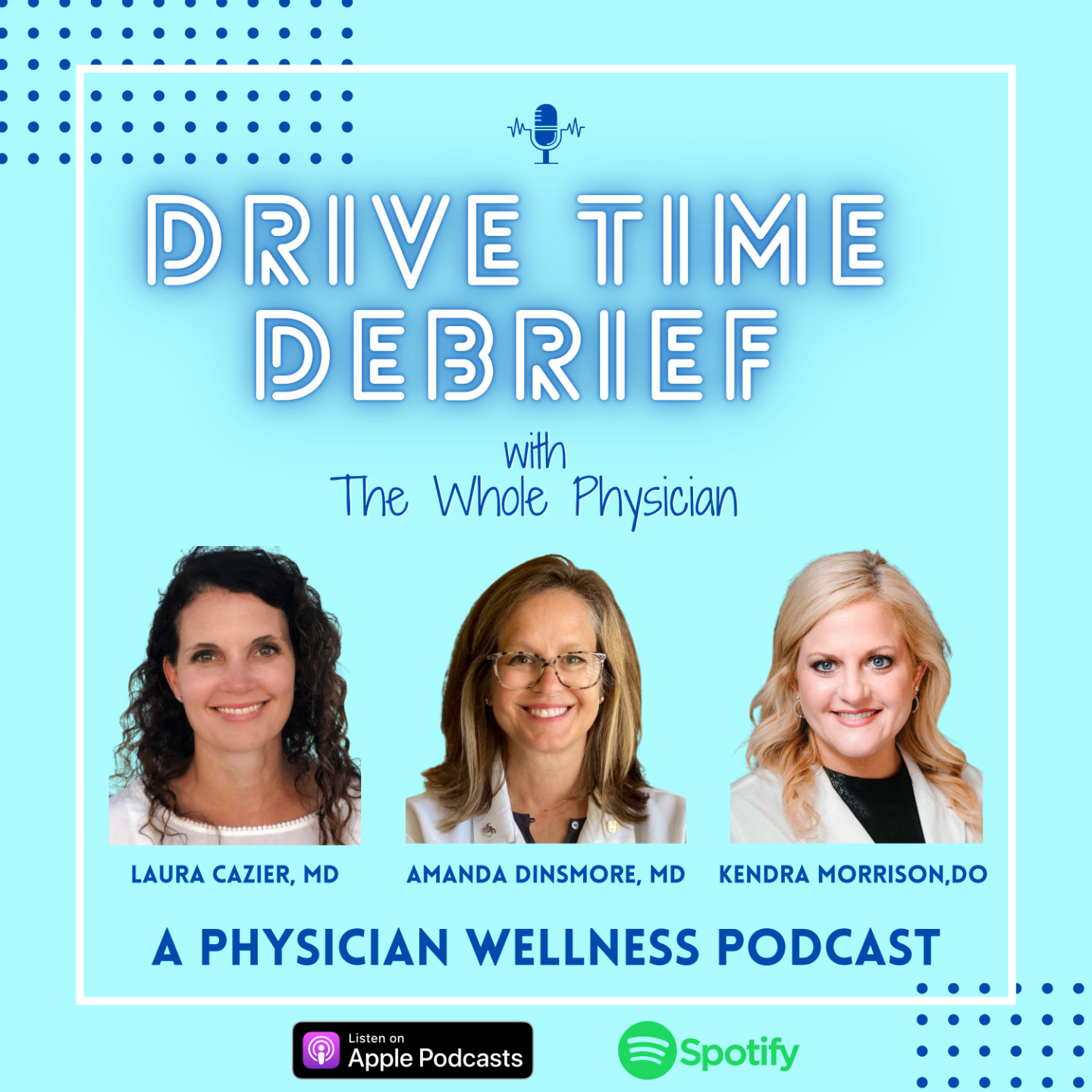
Welcome to the Drive Time Debrief with The Whole Physician, a podcast to burnout-proof your medical career with candor, humor, and encouragement. You spent tens of thousands of hours learning how to care for others, but now it's time to learn proven tools to care for yourself. If you're tired of feeling stuck, disillusioned, and exhausted, you're in the right place.
Start your journey to bring back contentment and purpose. Now, here are your hosts, three board-certified emergency physicians: Doctors Morrison, Cazier, and Dinsmore.
Hey, guys. Welcome back to the podcast. I'm Amanda. I'm Laura. And I'm Kendra. And today we're gonna talk about connecting with people you love when you have nothing left. Kendra's gonna tell us a little bit about that. Yeah. You know that feeling when you pull into your driveway and you just kind of sit there?
Anyone? Holler back. I know. You may turn the engine off. You may still have your hands on the wheel. You're just a little shell-shocked. I don't know. You just kind of got there. Maybe you're not really sure how you got there, 'cause I've asked myself that question before. But also, you're bracing, and you're bracing because you realize you have nothing left, and you realize that the people inside are gonna need something, and you're just not sure how you can even show up.
And that's not dramatic. That is not you as a bad mom or dad. That's not you as a bad spouse. That is just your nervous system telling you it's still back in the trauma bay or the clinic or the hospital. You're still processing that family meeting, the delivery of devastating news.
You are still absorbing the unruly patient that just yelled at you for seemingly no reason, right? The family that got irate, the news you had to deliver, all these things that you don't control, that you had zero control over, and it's all hitting you at once. So today we're talking about something nobody puts on the slide deck in residency.
Nobody taught me this in med school. But what happens? How do you even show up? How do you even go inside when you have given everything you have to your patients all day, and you just cannot walk through your own front door because you have nothing left? This is not a blame game, and this is not calling anyone out.
This is a real thing, and for a long time I had no idea how to get inside. Unfortunately, I played the game where I would think, "Okay, it's about 30 minutes till bedtime, so I'm just gonna sit here for about 45 minutes, and when I see the lights all go out, then I'll go in." I was hiding, but I also didn't even know if I could take somebody needing something from me for one second. And it's not your fault.
So let's just get into it. I know there are a lot of our listeners out there who can definitely feel this, and we all three experienced it. I just wish I could have been aware of it. Maybe I would have used my commute more wisely, or maybe I would have been able to prep, even just getting in the car knowing that's my cue to get regulated, find myself again, debrief from the day, and then try to show up with some semblance of being a mom and a wife and all the things.
Okay, so let's start with a story, because sometimes, honestly, that helps us get the picture a lot easier than us just lecturing at you.
So it's 7:42 PM. A physician, we're gonna call her Sarah, although name her whatever you want, pulls into her driveway. She sits there for four minutes before she goes inside, not because she forgot something in the car, not because she's finishing a call. She's not even scrolling. She just sits there because she has nothing left, so she needs those four minutes to figure out how to muster up having something, anything.
Eventually she goes inside, and her eight-year-old runs up with a drawing and wants her to look at it. Her husband asks her if she's eaten. The dog wants any sort of attention from her. His tail is wagging furiously. And Sarah, who just spent 11 hours being patient with strangers, staying calm during a code, and regulating her face when somebody said something that was...
That was my... regulating my facial expressions was truly a big use of the energy that I had. Being kind to a family who was truly screaming at her in the hallway, all of that has used up all of her executive function and her emotional capacity for the day, and she has nothing left for the people she actually loves.
And it's not because she doesn't love them. She is out of capacity, and those are two completely different things, but we treat them like they're the same. So what does she do? She smiles at the drawing without really looking at it. She's already kind of checked out. She says, "Great, honey." She eats standing up at the counter, because sitting down for a full meal feels like something she just can't complete right now, and she goes to bed by 9:15 without saying much of anything to anybody within her four walls.
And here's the thing. When we say all that, we realize that nobody in that house did anything wrong, and neither did she. Her husband didn't do anything wrong just by asking if she'd eaten. Her kid didn't do anything wrong just wanting to be seen, wanting to talk to Mom.
And Sarah didn't do anything wrong by being exhausted. But this is not just one time. Unfortunately, it happens over and over again, and that pattern is where it becomes dangerous. And like I said, just recognizing this is huge, because this went on in my career for a long time and I had no words for it, no language for it.
I just knew that I couldn't go inside, right? And it was shift after shift after shift. It didn't matter if I worked a day shift, a mid shift, or a night shift. And well into my career, it was literally like I just checked out. My husband and I would just talk about the bare minimum: what's going on this week, who has to show up where, are you gonna be available or not?
Just coexisting, right? And then with the kids, it was just, "Did you get your homework done? Did you get this done? Okay, good. Now let's go. Bed." It was the very finite amount of energy that I had to perform the functions I needed to. And I think the reason this story lands so hard for us as physicians specifically is that we've been trained to believe that this is just the cost of doing this job well.
And if you're not depleted, are you even really trying? Did you even show up today, right? Were you even working hard enough today? 'Cause if you have something left, then you didn't give all you had today to all of your patients and staff and everybody else. When I think about that, it's kinda messed up.
That's kinda messed up. That's a warped way of thinking about it, but that's exactly where we want to go next, because this does not happen by accident. This was actually a trained behavior. I just wanna say this was me too, and it wasn't four minutes. I can think of at least one time I stayed in the car for four hours.
It was after an evening shift, and I don't know, it's kind of like this shell-shocked feeling. But I would routinely stay in the car for an hour before going inside. Usually it was that same scenario where I was coming home and everyone was already in bed anyway. I just didn't feel like I could move.
So you're in good company. A lot of people do that to try to make sense of what they just went through at work. So let's talk about where this actually comes from. From day one of medical training, you're taught, explicitly and implicitly, that the good doctor is the one who gives until there's nothing left and then finds a way to give more.
I remember that in residency. I remember even teaching this to younger residents. Once you get to residency, people don't care as much about what you know. They care how agreeable you are, how easy you are to work with, and how hard you work. That can make sense when you're trying to take care of patients, but it's also a recipe for grinding yourself into the ground, where you skip lunch and that's called dedication.
You stay late, and that's called commitment. You run on four hours or less of sleep, and somehow you're still showing up. You think you're showing up sharp. We think we are. We're probably not. And that's the story we tell ourselves: this is what it is. And maybe someone says, like in Hamilton, "The man is nonstop."
We're all like, "Oh, we wanna be the nonstop person." It's the highest compliment you could give someone. But none of us are pausing to ask, "Nonstop for what?" Never stops giving to patients or to the hospital? Yeah. But that same nonstop doesn't turn off when we leave the hospital or leave the clinic.
It follows us to the car, follows us home, follows us to dinner, follows us to bed at night. So we're lying there trying to make our brains shut down so we can sleep. And obviously this contributes to burnout. We talk about burnout as if it's only about how many hours we're at work, and crappy call schedules, and the EMR, and having to chart till midnight just to keep our heads above water.
Those are all true, and then there's this other contributor that maybe we neglect to talk about, and that's giving everything to patients all day and then having nothing left for the people you'd give anything for, or at least you say you'd give anything for, the people who matter most.
And we get home, and we're just a shell of who we want to be with them. The gap between who you are at work and who shows up at home is exhausting in a psychological way, when we realize we're just not who we wanna be, and we're not able to even connect with the most adorable little kids.
I've heard multiple doctors talk about this feeling of coming home, having sweet little toddlers who just want to spend time with them, and just feeling numb and not being able to reach them in a connecting way. And again, it's usually not about the schedule that we're working. It can be a reasonable schedule, and we can still be running on empty at home, because the depletion is about capacity and where all that capacity got spent.
Yeah, that's a great point, because I think we could take a step back and discuss the myth that's underneath all of this. There's a belief that a lot of physicians are carrying that we really need to say out loud. The belief is: the more depleted I am, the more it proves that I care, or the more given out I am by the end of the day, the better a physician I must be.
And it's everywhere. It's reinforced. We see it all the time: "Oh, wow, thank you for taking that extra shift for six months in a row," right? I'm not really sure they had the bandwidth to do that, but it's reinforced, it's praised as some kind of heroic measure, and it's a lie. Because being the most tired, the most depleted, the most given out in the building does not make you the best physician.
And if you're hearing this for the first time, it's gonna sting, because that is how we were trained. But if you hear it the way we're trying to present it, full of love and awareness and gentle correction... We don't want our physicians to be the ones at the end of the runway who are running out of runway and have nothing left.
Somewhere we've confused exhaustion with excellence, and that is never the same thing. We talk to our clients about this all the time: is showing up as the best version of yourself really possible after four hours of sleep, or is there a well-rested, better version of yourself that we could work toward?
And here's the part that actually matters for staying in this field, for retaining any amount of longevity in this career, and it's not just for your marriage or your kids either. A physician who's completely given out by 7:00 at night every single night is not a physician who is going to make it to year 20, or 15, or even 10, right?
This pattern is not sustainable. It's a slow leak, and eventually, when that tank runs dry, in medicine, at home, and everywhere at the same time, it is going to be a disaster. So we wanna give you permission to start telling the truth about what your situation is. A lot of the problem is that we've been trained to hide the depletion and exhaustion, so when somebody asks how you're doing, you default to, "I'm fine. Living the dream."
But I think the first real shift is this: let's start to be honest with ourselves and with the people we love as well. It's not complicated, and that's why it can be such a relief to be able to say the sentence, "Hey, I honestly don't have anything left for a conversation right now, but I do wanna sit next to you."
That's it. That's a complete, connective, honest sentence, and it costs you nothing compared to the whole performance of, "Oh, yes, of course. Let's go on an adventure," when you're completely exhausted and have nothing else. The performance of "I'm fine" is expensive. You're spending energy you don't have, pretending that you have energy you don't have.
So it's circular, and it's exhausting, and literally no one is fooled by it, because I promise you, your kid can tell. Even your dog can tell. Your spouse definitely can tell, too, that something's not adding up here. They know something's off. They just don't have words for it, so they start to internalize it, and that's the problem: people will start to blame themselves when they had nothing to do with it.
It might look like, "Mommy doesn't wanna be here," instead of, "Mom is depleted and doesn't know how to say so." That distinction matters so much, because if we don't say it, people will fill in the blank themselves, and they usually fill it with something worse than the actual truth. Kids especially: if you don't tell them, "I'm tired," they'll tell themselves, "Uh-oh, maybe I did something wrong," or, "Maybe this just doesn't matter."
So when you say something honest, that's not weakness, it's really generous. It is a gift you can give everybody you love. It's the same way with a partner. "I'm running on fumes tonight" explains why you're behaving that way. It answers the question of what's going on. It lets them meet you where you are instead of where you're pretending to be.
This actually connects to some research from researchers I really respect, Drs. John and Julie Gottman. They have spent decades studying what makes relationships last, and they have a concept called a bid for connection. A bid for connection is any small moment where someone reaches toward you, like the little kid showing you a drawing or asking how your day was. They just want to connect with you, to have your eyes on them for a second.
Their research found that the couples who thrive are the ones who turn toward those bids, even in small, imperfect ways, way more often than the couples who drift apart. So it's really about tiny little moments. I was working with a client recently, and she was describing this feeling of being disconnected from her child when she was at home.
It's important to understand that this is oftentimes a way our nervous systems are trying to protect us, and we just feel overwhelmed. So if we can take a moment, when someone approaches us or when we approach them, and use our bodies in some way to help our brains realize that we're safe and okay.
With a little kid, a great way is to just give them a big hug and sniff the top of their head. Doing that gives you a little boost of oxytocin and will help you feel more connected. Or just holding hands, or sitting close to someone who feels safe. Those things can help our brains get out of the state of shutdown that we might be in, because we're coming from a place where we not only felt completely exhausted but, a lot of the time at work, don't feel psychologically safe.
So turning toward the people we love can feel like we're using energy we don't have, but it is a self-care move. It's something that will produce more of what we want in life, and more energy, actually. So in the situation we were talking about with Sarah, she didn't need to give her kid a Pulitzer-worthy reaction to the drawing.
She didn't have to be dramatic. She just needed to look at it for four seconds and say something true about it or ask a question. "Tell me more. What about this? What made you decide to draw this today? Tell me why you chose the colors you did."
That is turning toward, and it produces some of the connection that can be healing. Just glancing at it and saying, "It's great, honey," without looking up, or without looking away from her phone, or just being kinda zoned out, is actually turning away. She's of course not intending to reject her child, but that's how it can land in that moment.
The Gottmans talk about this building up like an emotional bank account. Every time you turn toward someone, even in a tired way, you're making a deposit. Every time you turn away, you're making a withdrawal. And interestingly, the positive interactions unfortunately do not weigh the same as the negative ones.
According to Gottman's research, for every negative interaction we have, we need at least five, and some studies say up to 20, positive interactions, so when we withdraw from that emotional bank account, it goes down much faster than we can build it up. So it's so important for us to be intentional, even when we're tired, to take those little moments to put a little bit of love in our loved ones' emotional bank accounts.
Nobody's gonna go broke from just one bad night, but people do go broke from years of withdrawals that never got balanced out.
Okay, so let's get practical here. If you feel seen and heard by this podcast but don't have anywhere to put it, let's talk about that now. One thing you can do is narrate your state instead of hiding it, and that's the permission Amanda was talking about: "I have nothing left for this conversation, but I do wanna sit next to you."
That is honest. That is a lot easier than the performance of "I'm fine," or whatever else you feel like you have to muster up. And even if it seems like this would be a hard thing to say... I know that in my own experience with my spouse, who is a physician as well and is a turn-and-burn kind of guy, I always felt I just didn't have permission. As long as he was working hard, I felt I had that same debt to pay. So it was very hard for me to be honest, and I would just keep going.
But once you do it once or twice and then practice it... This is something my own coach had to work with me on a lot, because I wasn't honest with the people around me. I wanted to portray that I was strong enough, that I had it all together. If you showed that you were tired, that meant you were weak, and how were you even cut out for this life? That was my narration. I did not cut myself any slack. But it gets a lot easier every time you say it. And even though that first time was awkward, now this is the honesty that comes out, and I hear my husband say it every once in a while, or even my kid.
Just be honest: "Hey, I had a rough day. I'm just gonna sit here." Or, "I'm overwhelmed by how that game went. I don't really wanna talk about it." My son said that a couple of weeks ago after a football game that didn't go well, and it was like, "Okay, yes." That was huge. So realize that the more honest you can be, and the more you show up and narrate your state instead of hiding it, the better, because it doesn't say anything about you as a person. This is your state right now. This is what happened after a long shift or a long week. And being honest with those around you almost allows them to reciprocate, and that's huge.
Number two: try to build a real transition. We've talked about this a lot. You cannot go from a code blue, or a high-intensity acute shift, or delivering bad news, or 11 hours of decision-making, straight into, "Oh, how was your day, sweetie?" with zero buffer, right? My favorite was coming in, if I made it inside while everyone was still awake, to, "What's for dinner?"
My nervous system was not ready for that at all, and it does not switch that fast. That's when I would absolutely lose my marbles. That's when you see that threshold go way down, and you snap, or sometimes you just withdraw. You go quiet, because you're afraid that if you do open your mouth, it's going to be a disaster, and you might say some things you don't really mean.
So this is that driveway moment we opened with. This is not wasted time. This is actually the most productive five, 10, or 15 minutes you could spend in the car. I started using getting in the car from my shift as my cue: "Okay, this is my cue. I'm getting in the car. This begins my debrief or my reset." Some people need to fully go inside, change their clothes, maybe wash their face, maybe even take a shower. Just get that hot shower, and be able to almost feel like you're washing the woes of the day away. This is not indulgent. This is not, quote-unquote, "self-care."
This is a necessary transition that we need to build into our regular routine, because that is how you show up physically, emotionally, spiritually, whatever you wanna say. It's about being able to be physically present versus, like I said, checked out, but there.
And then number three: trade duration for presence. This is like what Laura said. You don't have to do 90 minutes of full-on story time, playtime, all of these things. The quantity is not what means the most to the people you love. It's the real eye contact, the holding of hands, the 90 seconds of just looking at the artwork, looking at your kid, and really connecting. That is what really matters.
That's the turning toward, and really giving that authentic "I wanna connect, and this is what I have, but I wanna make it meaningful." So it's not about mustering up a whole bunch of energy you don't have. It's really just full eye contact, or holding a hand, or saying, "I'm so exhausted, but can we sit together on the couch?"
This is the point: the quality of that time, and all of these things, leading up to being able to show up for the people who mean the most to you. And you don't have to wait to start doing this until a good day. I'm not sure we have many good days at work where we come home and think, "Wow, that day gave so much back to me, so I can give so much back to the people I love."
You can start this even on your worst day, and especially on the worst day, because that is when this practice really becomes the place where you can use it and manifest it in a way that's gonna mean the most.
So here's what we wanna leave you with, and this cuts to the core for a lot of physicians. Your worth as a human being has absolutely nothing to do with how productive you are, how many patients you saw, how many surgeries you performed, or even how many people you helped that day. Your worth has nothing to do with your output. But it makes sense, because a lot of us have been taught that.
Definitely our systems of training reinforce that. So sometimes you might think that your exhaustion means you get a pass to disappear from the people you love. Or maybe you are telling yourself some sort of false narrative, that if you show up depleted, you're failing in some way.
I think those are just things to notice. Somebody benefits from your exhaustion, but I would guess it's not you or anybody you actually care about, so becoming aware of that is gonna be the first thing. Being honest with yourself, I think, is the key takeaway from this: being honest with yourself and the people you love about what's going on. Because I think if you're forced to be honest, the 50th time you tell your kid, "I'm too exhausted for anything you wanna talk to me about," that is gonna be a wake-up call, at least for me, that to make this career sustainable, I'm gonna have to start getting a lot better at boundaries.
And that's ultimately the goal with this: to start to be honest. First of all, that's a lot better than faking it with the people you love. And number two, once we get brutally honest with ourselves, it's gonna force us to start making some decisions and doing something about it. So listen, I don't want anybody to feel guilty that they have some exhausted days with their kids.
That is the last thing I want you to take from this, 'cause it just is what it is sometimes. Sometimes there is no control over that. But don't think you can have connection only if you're not tired, 'cause that's not the case. It can be a real, authentic human moment to spend time with somebody you love while you're still tired, as long as you're not acting the fool.
Yeah. So just keep that in mind. You are allowed to say, "I'm running on fumes," and reaching toward your family a bit, instead of pulling away from them, is sometimes the most healing thing you can do for yourself. Yeah. And I'm thinking of another client now. Before you say yes to the next unpaid committee...
That's gonna take hours out of your life every month... remember how tired you've been with your family, and ask yourself, "What am I saying no to when I'm saying yes to more unpaid work?" And just remember, I could be wrong, but I don't think any of us went into this profession with the goal of becoming the most depleted doctor we could ever be.
And yet... some of us still, it seems like that's the goal. And it makes complete sense, as Amanda said, because we were trained that way. Not just in our training. A lot of us grew up feeling like we had to earn worth in our family of origin. So it is normal that we would do this, but it's not adaptive, it's not healthy, and it's not true.
We don't earn our worth. Being depleted does not measure how good you are at being a doctor. In fact, it will make you a worse doctor, because you will start hating everyone around you. So stop. It's time to stop giving away our worth, our life, to people-pleasing and to the system that trained you to think that being completely worn out means you're so dedicated.
You get to decide differently, and you can decide today that you're done with that. So if this conversation we've had today hit close to home and you wanna talk it through with someone who's lived it, hello. Welcome to... Recovering People Pleasers Anonymous. Yeah. Not-so-anonymous. Welcome to the fam.
Yeah, welcome to the fam. You are not alone, and we love helping doctors wake up to this, to what we've allowed to happen in our lives, and choose something different. It is so much fun. I love helping people with that. So just click the link in our show notes to book a session with one of us. It's free to try, and we'll help you get some insights during that time, we promise.
No performance, no gold star earning, just real conversation. Yep. This is hopefully, as you've gotten to know us, a safe space to really just explore some of this. And even if you've been realizing this for a while, our brains do offer up, "We know the right thing to do," and sometimes it's just really hard to take the first step.
So hopefully we've given you a few ideas or just a gentle nudge. And if you need to take the next step and talk to one of us, we are here for you. We've all been in this place, we've all had the hard conversations, and we've all done the introspective work, and we are so much better on this side of it.
And we want that for you. So even if you're feeling guilty, guilty's great, because it just means that it's a behavior you wanna change and you wanna do better, and that's great. It has nothing to do with who you are, your identity, or what it says about you as a person. This is a good place to start and a good place to begin this work.
It will pay off, we promise. We're all standing here talking about this from a place of recovery and healing. And actually, it's a constant reminder, because some stuff still creeps back in, and it still requires that "Oh, if I say yes to this, what am I saying no to?" So that's it for today's episode, friends.
If you found this conversation helpful, the best way to support us is always to subscribe. So click that button now and leave us a rating and review. It helps other physicians find our podcast, and it moves us up on the list. And if you do leave a review, take a quick screenshot and email it to [email protected].
We'll send you a free e-book on emotional regulation, which is one of our most requested and impactful topics. And don't forget to follow us on the socials at The Whole Physician. We love connecting with you there. And before we go, we'll tell you about our Weekly Well Check. This is our newsletter that comes to your inbox every Thursday.
It's little bites of encouragement, and you'll get all the details of what's going on with The Whole Physician, including our upcoming master classes, so click that link in the show notes to sign up. Thanks for spending time with us today. Until next time, you are whole, you are a gift to medicine, and the work you do matters.
Thank you for joining us for the Drive Time Debrief. If this podcast has helped you, be sure to share it with others. Please subscribe and leave us a five-star review so other doctors can find us. If you want to know more about what we do or work with us, go to our website at thewholephysician.com and schedule a free 30-minute strategy session.
We'd love to help you create the life you dreamed of before things went awry. It's absolutely possible.