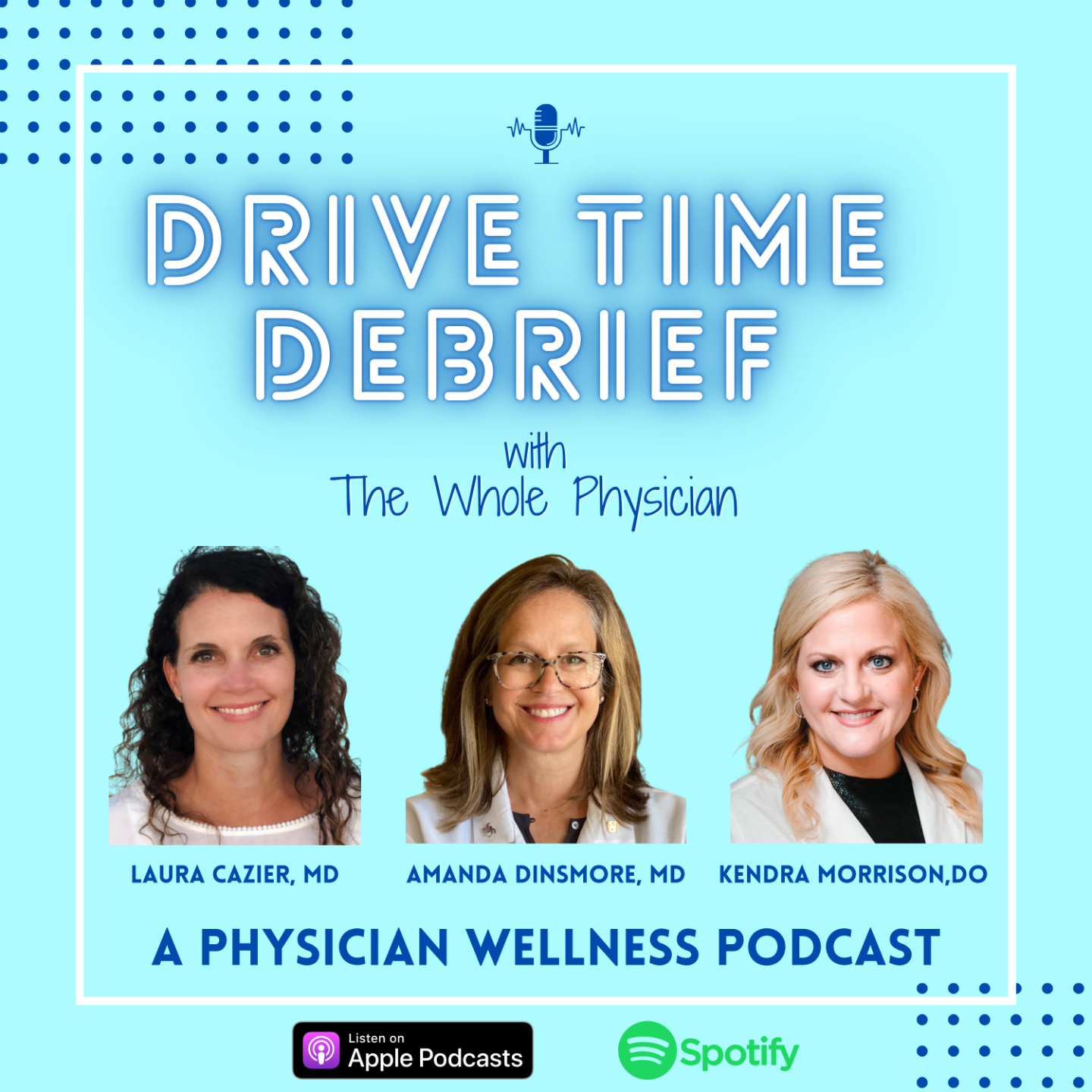
Hey, guys. Welcome back to the podcast. I’m Amanda. I’m Laura. And I’m Kendra. Today you’re in for a special treat because we have a special guest star. Dr. Neil Farber is a physician, educator, and communication researcher whose new book, coming out this October, is called Treating a Broken System: A Physician’s Cure for the Healthcare Crisis.
He draws on more than 40 years in medicine to unpack the human toll of physician burnout and what it will take to fix it. A professor emeritus of clinical medicine at UC San Diego, he practiced internal medicine for nearly three decades and has published more than 60 papers on physician-patient communication, as well as medical ethics.
His perspective has taken on a new dimension in recent years. Not only is he a physician himself, but he has also recently navigated the healthcare system from the other side, caring for his wife through brain cancer and facing serious health issues of his own as a patient. It is our pleasure, Dr. Farber. Thank you so much for joining us.
Thank you for having me.
Okay. You talk about your new book, Treating a Broken System, which comes out this October. What made now the moment to write it?
At the end of my career, I noticed more and more time pressure on myself as well as my colleagues, but we all managed. There were some decisions we weren’t happy with, but I made the decision to retire because of caring for my wife more than because of the time pressures. I was keeping up with things. When I became a patient myself in 2024, I suddenly saw physicians who couldn’t communicate with me. I saw physicians I couldn’t get appointments with for long periods of time. And I thought, “Well, if this is happening to me as a professor emeritus, what’s happening to the average patient?” I began researching it and realized that this is happening across the whole country, and it really is a healthcare crisis.
Yeah, that makes sense, especially getting to experience the other perspective, the other side of the stethoscope, as we sometimes say. That’s really good perspective. You mentioned communication mistakes, or just being unable to connect through communication with the physicians taking care of you, and they might not have even realized it. What do you think are some of the biggest communication errors, or where do we lack in communication? Why did you, as the patient, leave feeling unheard, or not even able to get to that point?
I think the biggest thing is physicians not being able to understand who the person in front of them is. We look at the patient with particular illnesses and symptoms and think about how we are going to evaluate and treat them, but we don’t think about the person behind this. I think that’s the biggest mistake, and it leads to things like not having shared decision-making and not being able to diagnose and treat the patient appropriately. So I think that’s the biggest mistake that physicians make.
Why do you think physician burnout is more complicated than just doctors working too many hours? And how does burnout actually show up in the care our patients receive?
I mean, the number of hours is a factor, no two ways about it. But it’s more than that. It’s when you’re seeing the patient and don’t have the time to interact with the patient adequately. In my own practice, most of us usually had 20 minutes for a follow-up and 40 minutes for a new patient. That’s pretty average. But toward the end of my career, half of that time was taken up by our clinical staff, the nurses and medical assistants, having to enter all kinds of things into the electronic health record, leaving only half the amount of time with the patient. So that’s part of it: physicians don’t have the “luxury,” quote unquote, of being able to spend time with their patients.
I think the other thing, and this is a big consequence as well, is that administrators aren’t listening when the physicians say, “Hey, we’re drowning. You need to help us.” Most often, they just throw something at the physicians that doesn’t work.
Like pizza.
Yeah, like a snack cart.
Well, like pizza and like telling physicians that they just need resilience. That was the one that really got me.
Yeah. We say all the time that there’s not a more resilient group of people than those who have endured residency training.
It’s absurd. There are actually studies showing that physicians are much more resilient than the average population.
Yeah, that’s not a surprise to us at all. So you’ve spent 40 years as a physician, kudos to you, and the last two as a patient yourself and caring for your wife through her illness. How has that experience reshaped the way you think about medicine, and maybe even how you would teach doctors to deliver bad news?
That’s interesting, because one of the things I focused on was communication skills, and I had joined a group that researched and taught communication skills, among other things: the Academy for Communication in Healthcare. But I was never really taught how to deliver bad news. That never came up, certainly not in my training, and not even in some of the discussions I was part of. When I saw my wife get the diagnosis that she had brain cancer, delivered in a very inappropriate way, I realized, “Hey, this is something that no one talks about or teaches.” So I began looking for ways to teach it more adequately and to talk to other physicians, as well as residents and students, about how to deliver bad news.
Would you be willing, and please say no if it doesn’t feel right, to share what that poor delivery of bad news looked like and what it would have looked like if it had been done well? I certainly learn better through examples, and I think a lot of our listeners do too.
Yeah. I actually talk about it in the book, so yes, I’m okay with it. It’s been long enough that the pain has subsided and is just a memory now. Basically, she had a history of migraines, but one night she woke me and said, “This is not a migraine. Something’s going on,” and told me that, yes, she had the headache, but her left arm was rhythmically shaking. We saw a neurologist right away, who evaluated her and said, “Well, it could be just a change in the migraines, but let’s do an MRI just in case.” So I took her for the MRI, and I went off to work. You have to know that she was in her PhD program for neuroscience, so she knew about brain anatomy and physiology.
The neurologist called her on the phone after I had gone to work. He didn’t make sure anybody was there with her, and said, “Well, I got back the results of the MRI, and you need to see a neurosurgeon right away.” She said, “Why? What’s going on?” And he said, “You’ve got white in your brain.” And she said, “I’ve got lots of white in my brain. What are you talking about?” He said, “There’s white where there should be gray matter.” And she said, “Is this a brain tumor?” She was pretty knowledgeable and knew that that was a possibility.
Mm-hmm.
And he said, “I don’t know,” which was a lie. “You need to just go see a neurosurgeon right away.”
Mm-hmm.
So she called me crying. I sped home, the fastest I’ve ever gone, to be with her and hold her. And I said, “Look, we’re going to go get this taken care of.” So we saw the neurosurgeon, who put up the MRI films and said, “Here’s your tumor in this projection. Here it is in this projection. I can either do a biopsy and find out exactly what it is, or I can take it out and give you maybe another year or two of life.” She started crying. I held her, and he just stood there and looked. All of that was bad.
Mm-hmm.
The neurologist should have waited and said, “Look, why don’t you and your husband come in? We’ll discuss the results,” et cetera, so that we would be there in person and he would know that she had support with her. Buckman goes through the whole mechanism of how to give bad news, which basically starts with what the patient knows and works from there. The neurosurgeon should have done the same thing. We were there in his office. He should have said, “What’s your understanding?” and gone from there. He should have said, “Yes, it is a tumor. I don’t know exactly what it is yet. I can either do a biopsy or remove it. My preference would be to take it out. That’s what I recommend, but there are other possibilities.” That would have been shared decision-making.
I think that is a really valuable example, because many of us, in the busyness of clinic or whatever we’re trying to accomplish, and in talking to another physician and his wife, might feel that we could take a shortcut and just be more matter-of-fact. And obviously the impact of that was really negative.
Very, very negative.
And that leads us to the fact that there are real constraints on doctors’ time to have these kinds of conversations. What do you think a real partnership between physicians and administrators could look like to actually address the root of these issues, not just physician burnout? I would also say that the way these two physicians behaved could certainly indicate they were experiencing some burnout, a low-empathy state.
Right. I began looking at how this could work, rather than at piecemeal attempts to fix it, which don’t work. I found the perfect example in the literature, actually, because I had never experienced it myself, unfortunately. It occurred at the Mayo Clinic in Rochester, Minnesota. They had a terrible problem with burnout, and the administrators got smart. They reached out to the physicians and said, “We want to have a representative of the physicians sit down with us, the administrators. We’re going to have this program where we just sit there and listen to what your problems are. We’re going to list them, and then we are going to give you, the physicians, the authority to make the change, with the financial and administrative backing of administration.”
Whoa.
“And after you do that, we want you to go and recruit other physicians to join us to continue this process.”
Wow.
Burnout was gone.
That is amazing.
Burnout was gone. They made all kinds of changes that improved the situation for the patients as well as the physicians. And lo and behold, the fear of administration is that if you give physicians the authority to do this, they’re going to spend all kinds of money and put the place into bankruptcy. In fact, they made more money doing that than they would have with the way they were trying to approach it.
That is amazing.
And that’s the institution where psychologists developed self-determination theory, which addressed the need for autonomy, belonging, and a feeling of competence in preventing and treating burnout. So that was a direct application of it.
Yeah. Wow. I think the biggest factor in my burnout was the feeling of learned helplessness. I tried to get involved and tried to do some things, and then felt like, “I don’t know that what I’m doing really matters.” And yet at Mayo, they’re saying, “Here’s the budget. Here’s whatever.” I think most physicians understand that this is a business. We can’t lose money and have everyone keep their job. So I feel that there’s a way we can all get on the same page and have a shared goal.
Yeah. I was very grateful that UCSD spent a million dollars, and a lot more after that, to have a robotic surgery unit. They train the nephrologists as well as others to operate it. They maintain it, which costs around 100 grand a year. And they used it on me to take part of my kidney out, which ended up being a two-day stay in the hospital, with me needing only Tylenol the day after surgery, instead of a week in the hospital with most of it on narcotics.
Yeah, that is incredible. Wow.
So I understand that they want to have the money to do things, even if they’re not-for-profit. But they have to understand that physicians also need help. This is something they need to invest in as well.
Absolutely. You’ve pointed out that poor communication, burnout, and declining trust, which I think are probably all related to each other, are delaying care and putting patients at risk. How do you think we got here?
Well, I think the electronic health record, when it was first introduced, was touted as a miracle. It was going to give physicians access to records right away. It was going to speed up how physicians do their notes, et cetera.
Yeah, not really.
No. But it became even worse, and this is no fault of the health record or administration or anybody, it just sort of developed, when there were patient portals, and then the CARES Act, which said you had to release lab and X-ray data right away. This added to patients’ worry, and they called more, et cetera, et cetera. And insurance companies required more and more pre-authorizations. So physicians are more and more under the gun in terms of the clerical work they have to do while also doing their clinical work. That led to physicians having burnout and coping with it by reducing their number of sessions or hours, by going into concierge medicine, or by leaving clinical practice altogether.
Yep. We see it all the time. For sure. For those of us who have that learned helplessness and feel like we don’t have any sort of agency, we’re not getting the budget from admin to change our circumstances. As we mentioned before, we happen to be more resilient than the average human out there, so we just put our heads down, get through the day, and then get through the next day, and then the next. But for a physician listening today who feels stretched to the breaking point, what’s one practical step you would suggest toward real wellbeing?
I think the only way physicians can have real wellbeing is by addressing the amount of clerical work they have to do. The only way that’s going to happen is with administrative help. So I think physicians need to go to administration as a group and say, “We are drowning. We are going to decrease our hours or leave medicine, or you’ll be left without enough physicians to take care of the patients. Please, here’s...” Give them the article that the Mayo Clinic wrote and say, “Here’s the way to do it. Please do this.” If administration doesn’t listen, then unfortunately what a lot of physicians are reverting to, and I don’t advocate this because I think it’s not the best way of dealing with it, is unionizing. That just makes it an adversarial situation instead of a collaborative one. So I think people should get together and say, “Look, if you keep doing this to us, we’re going to leave in one way or another, or unionize and leave in a way you’re not going to like. But we want to work with you so that we can help the patients.”
Yeah. We’re obviously seeing tons of physicians already leaving because they haven’t been able to figure out another way to resolve this, and we recently had the first walkout I’m aware of, with physicians walking out, so maybe that’s where it’s going. But hopefully we can do something more like the Mayo Clinic. If you look at it from a business perspective, it’s insane for the person with the highest hourly rate to be doing clerical work.
Right.
It doesn’t make sense at all. So it seems like we should be in alignment, and yet, I guess maybe that’s not obvious to everyone.
Yeah. And like I said, I certainly don’t advocate physicians unionizing, but you’re going to see more of it. It’s actually on the rise, a major rise, like an exponential rise. About 10% of physicians have now unionized, and three-quarters of physicians say they’re interested or very interested in doing so. That’s a real threat, and administrators need to know that this is coming. The way to avoid it is to sit down and work with physicians to fix the problem.
That agency piece. Yeah. So let’s talk about your book. Tell us all about it. Where can we find it? How do we follow your work, for all the listeners?
Okay. So the book, as you said, is Fixing a Broken System: A Physician’s Cure for the Healthcare Crisis. It’s going to be released on October 5th. It will be available on Amazon and Barnes & Noble as a hardback, softback, or e-book, whichever you prefer. It will probably be available through Ingram in another couple of weeks, which means any bookstore can order it for physicians who are interested in having a hard copy. For those in the San Diego area, I have a book launch party happening on October 20th at Camino Books in Del Mar, so if you’re in the area, come visit me. It’ll be October 20th at 6:00 PM.
Okay. Well, we can make sure this gets released before that date, and we’ll definitely include links to your website, Goodreads, and the book on Amazon in the show notes for any listeners to find.
Yeah. Are there any last thoughts before we close?
No, except to say that I hope physicians at least read the book, preferably buy the book, so they know I’m not hawking it to make money. I did pay money to publicize the book, and I need to have that back. But anything above that, I am donating to charity, specifically two charities. One is the Academy for Communication in Healthcare, and the other is the Patient-Centered Outcomes Research Institute. I want physicians to know that this is not an attempt for me to make money. It’s an attempt to change the system.
Wonderful. Well, thank you so much, Dr. Farber. We’ve been honored to have you on this podcast today, and I just know that the work you have done, and will continue to do, will impact medicine well beyond your clinical years. So thank you so much. We’re honored to have you on the show today.
Thank you.
That’s it for today’s episode, friends. If you found this conversation helpful, the best way to support us is to subscribe, so click that button now and leave us a rating, five stars of course, and a review. It helps other physicians find the podcast, and it moves us up on the list. If you do leave a review, take a quick screenshot and email it to [email protected], and we will send you a free e-book on emotional regulation. I know, right? It’s actually one of our most requested and impactful topics. And don’t forget to follow us on the socials, @thewholephysician. We love connecting with you there.
Before you go, we’ve handpicked the best, or I would say high-yield, top 10 episodes out of our almost 250 episodes to jumpstart your journey to freedom from burnout. We’ve created the podcast fast track, so we’ve done the hard work for you. Head over to www.thewholephysician.com/fast.track to discover your personalized path to wholeness and healing.
Thank you for spending time with us today. Until next time, you are whole, you are a gift to medicine, and the work you do matters.