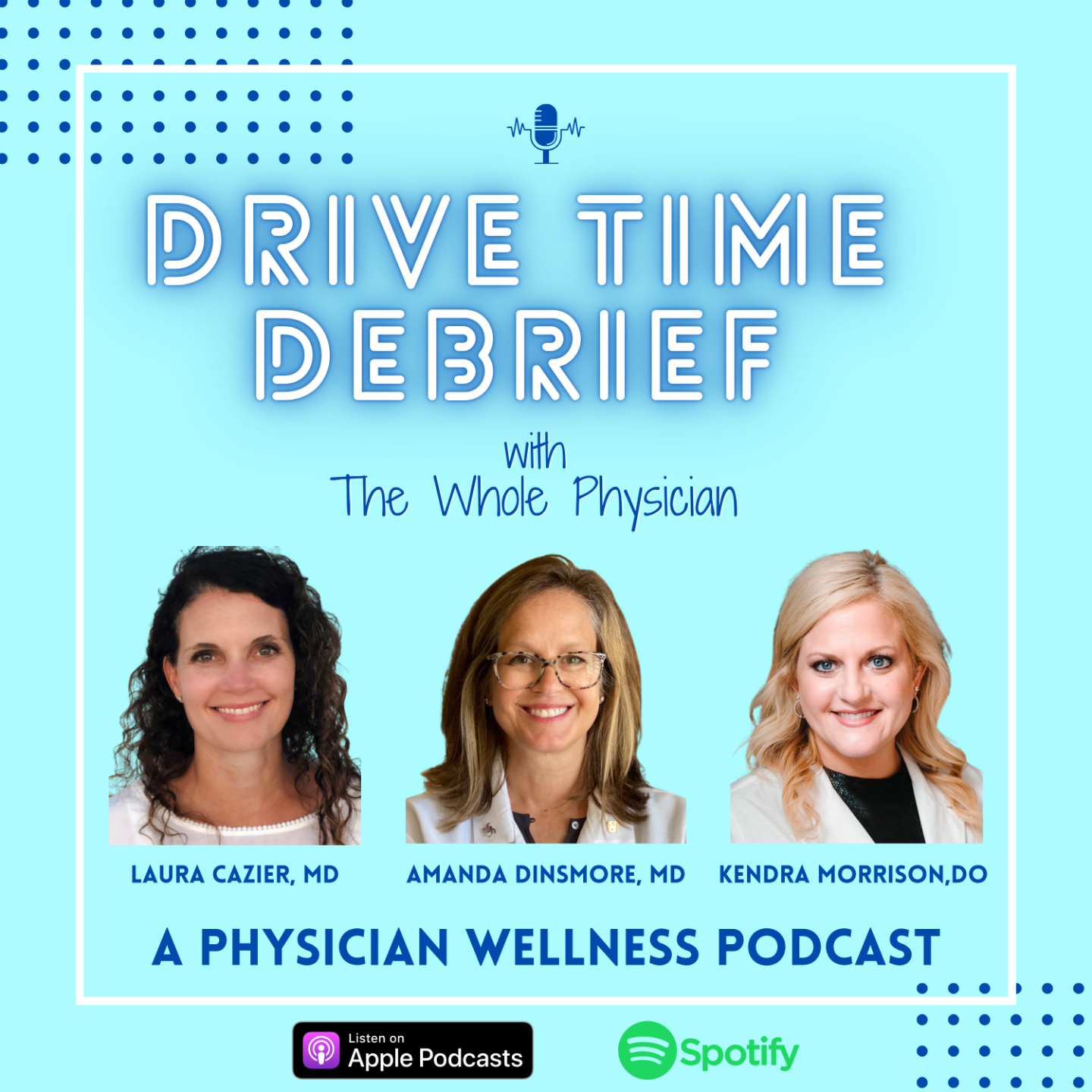
Welcome to the Drive Time Debrief with the Whole Physician, a podcast to burnout-proof your medical career with candor, humor, and encouragement. You've spent tens of thousands of hours learning how to care for others, but now it's time to learn proven tools to care for yourself. If you're tired of feeling stuck, disillusioned, and exhausted, you're in the right place.
Start your journey to bring back contentment and purpose with the power of your mind. Now, here are your hosts, three board-certified emergency physicians, Doctors Morrison, Cazier, and Dinsmore
Hey guys, welcome back to the podcast. I'm Amanda. I'm Laura. And I'm Kendra. And today we are gonna talk about when venting becomes relationship poison. And anytime we're talking about venting, I always think about Seinfeld, where they have Festivus and the annual airing of grievances. I do wanna try that sometime.
But maybe I'm gonna get some insight from... Maybe I don't want to try it. so, let's talk about how to get support without recruiting a jury. So if we're trying to make ourselves better, and sometimes what we talked about in the last podcast, we're just looking, like, conflict is uncomfortable for many, many of us.
Now, there's a few of y'all out there that absolutely love it. I just happen to not have a great model of how that goes. Like, we were definitely emotional stuffers. So I don't even know how to go about this. So something, you know, it might be a little easy to vent to somebody else or try to recruit somebody on your side without addressing it.
So- Let's talk about it. we've probably all said something to the effect of, "I, I just need to vent," and sometimes you do. Maybe you coded somebody for an hour and you're exhausted, and you just need someone who's been there and, like, to relate to another person. Maybe admin sent another email announcing an exciting new initiative that somehow creates 17 additional clicks, and you are eye-rolling like your eyeballs are about to come out of your head, right?
Maybe a consultant was crazy rude. Maybe a patient's family screamed at you. Maybe your teenager left a cereal bowl in the sink and there's, like, curdled milk, and you're like, " What is going on?" Maybe your spouse said the exact sentence guaranteed to activate every freaking nerve ending in your body.
My husband knows the one that does it for me. I don't know if you guys have something similar. And you just wanna tell somebody. That's totally normal. Human beings process difficult experiences socially. We're clan people, right? We need comfort. We need perspective. We need to hear another person say, " Dang, I can't believe you had to go through that.
That was a lot." So this episode is not anti-venting. Apparently, we still get to have Festivus. But there is a point where venting stops helping us metabolize an experience and starts actually preserving it. So instead- Hmm ... of releasing anger, we're rehearsing it. Instead of gaining perspective, we are narrowing in on w- what we're convinced of.
So instead of becoming more capable at addressing the situation, we become more convinced that the it's definitely the other person that's the problem. I, I... Look at me and my halo over here. Did you notice? So if you've ever noticed that you're starting to tell a story angry and finish telling it absolutely furious, like it didn't discharge any- it didn't bring anything down, o- you only ramped up further, then you know what we're talking about.
So today, we're gonna talk about three things. First, why does venting feel so good? Secondly, how to recognize when healthy support has turned into resentment rehearsal or coalition building, and then third, how to talk about difficult relationships in a way that actually helps you become healthier inside of them, because you absolutely need people.
We totally do. The goal is not isolation and never speaking another word when you're upset. The goal is learning how to seek support without accidentally constructing a jury. Yeah, that's good. I can definitely recruit a jury. We all can. Yeah. It's... So imagine this. You've had a terrible interaction. You are totally level 10.
Your heart rate's up, your jaw is tight. You feel that hot flush feeling. I mean, you're ready to fight. And you replay the conversation, and you are replaying it, replaying it as you're storming into the locker room or the break room, and it just happens, your bestie's there, and you tell the story, and they say, " Oh my gosh, that is unbelievable.
They do that to everybody." And somewhere inside that ramped nervous system, you feel relief. You aren't alone. Somebody, somebody knew it. Somebody sees what happened. Somebody agrees that you are legitimate. And that social validation can be deeply regulating. There's nothing wrong with wanting it. The problem is that feeling better in the moment doesn't necessarily mean the conversation is helping us in the long term.
And sometimes we confuse emotional intensity with emotional processing. It's just like I visualize like that, taking that cover off of the pressure cooker when you're letting the steam out, right? You turn that little knob and the steam comes out but did we really do anything to process? Yeah. It's not the same thing.
You can talk about something for forty-five minutes and never really process it. Sometimes you're simply reinforcing that neural pathway for forty-five times. "They shouldn't have done that. They shouldn't have done that. Can you believe he said that? Can you believe they said that? Can you believe they said that?"
And that repetition is strengthening that charged emotional response. But there's also something inherently seductive about telling a story from our own perspective because we know our own intentions. We know what we meant. We know what happened before the conversation, and we know all the invisible reasons our behavior makes sense.
But when we describe the other person, we mostly have their behavior, so the story naturally becomes, "This is what happened to me, this is why my response was understandable, and this is the crazy they did next." So the listener does something very human. They join our perspective because that perspective was what was made available to them.
They weren't there in the moment. They weren't present at the situation. They don't know what the other person experienced, and because they love us and care about us, they may be especially inclined to protect us, and this can be one of the dangers of repeatedly discussing this relationship conflict with people who care deeply about us.
They may become excellent witnesses for one side of the story that they have actually never seen, and sometimes we need that, and if you're dealing with, you know, abuse, like the severe cases of this, exploitation, harassment, serious mistreatment, outside perspectives can be essential, and secrecy protects unhealthy systems.
We're not talking about secrecy. We're talking about ordinary conflict where the support conversation slowly begins to harden our interpretation. So here's one question that might be able to help. When I finish venting, what has changed? And so pause for that just to think about that. Do I understand what happened better?
Do I understand myself better and why I was triggered in that situation? Do I have clarity around what I want to do next? Do I feel calmer? Or do I simply have more evidence for why the other person sucks, right? Because if every processing conversation ends at, " And therefore they are the problem" I don't know who ever does this. I mean- Sh- surely n- none of us, none of our listeners would be doing this. So let's talk about validation, gossip, and the sympathetic third person. We, we talk a lot in emotional health spaces or coaching about this concept of validation, and validation is really important.
Validation is just acknowledging that other people have the right to have a different experience than we have. Their feelings are their feelings, and we don't have to agree with them, but we're not trying to change them. We think that val- validation can sometimes be misunderstood. It really means I can understand why you feel that way.
It doesn't mean your interpretation is objectively absolutely correct. Those are two different things. So let me give you an example. Imagine a doctor says, " My department chair has it out for me." We might say, " Well, it sounds like that interaction really felt like rejection. Sounds like that felt terrible."
That's validation. We don't know whether their chairperson has it out for them or hates them But we're validating their experience. Or, " My spouse doesn't care about me." We can say, " Man, it s- that sounds like it feels really awful. It sounds like when that happened, you felt, like, completely uncared about and unloved."
We don't have to conclude that the spouse fundamentally doesn't care about them. Healthy validation acknowledges the emotional experience without pretending that we have all the information we need to s- to say whether their, the other person's motives were what our friend thinks they were. We don't have to pretend that we're omniscient and can read other people's minds and, and guess their motives.
That's an important distinction because sometimes what we want isn't actually validation. It's reasonable to want some validation. Sometimes we want corroboration. We want an ally. We want someone to say, "Yep, you are absolutely correct. Your explanation of that person is absolutely correct." And that sympathetic third person can be, it can be really tempting to seek out that person.
We all have people who are fantastic at this. You call them, and they're, like, ready to go. They're ready for battle. " He said what?" Like, I will be straight-up honest, I am this person for my daughter. she doesn't complain about her spouse, but if, if anyone-- she's complaining about anyone, I'm like, " Mama bear is out.
I'm ready to go." And, you know, I'm ready to go help you do whatever you need to do to get out of that situation or take that person down for you. And that, that can be a normal s- normal response. If you have a person like that, they are likely a great person, but they are not a great amateur therapist, amateur marriage counselor.
the problem isn't that they love you, 'cause that's great. They, they really love you. The problem is that sometimes loyalty and that protectiveness can replace curiosity be- about all the things that could be at play. And we all need to know our own part in, in these situations because when we have ignorance of what we're doing in a particular situation, we can't do the thing that we really have control over, which is address our own issues.
So one of the important questions to ask about this person we're talking to, that we're venting to, does this person love me enough to challenge me? Does this person ever challenge me? And not, not invalidate or shame or take the other person's side. Not playing d- I'm not talking about somebody who's playing devil's advocate all the time, because that's annoying as crap.
just someone who can validate the experience and also invite us to see if there's any, any other thing that could be missing, this is where having a coach is so helpful. Coaches do not just sit there and let us vent and blindly validate it. They give us information about what our mind is doing to h- to hide our own part, what our brain is doing to help us avoid the discomfort of us needing to change.
So a coach might say, " Can I offer another possibility?" Or, "Hey, it really makes sense why that hurt. I wonder if maybe we're assuming their intention, or maybe there's some facts that are missing, or maybe our brain is telling us a story." Or, "You've told me a whole lot about what they need to do to change.
What do you think your part is?" That is someone who is a valuable person, whether it be a coach, a therapist, a friend. That is a person who is valuable to vent to. And I think with all of this, we probably need to talk about gossip, because sometimes the line between venting and gossip gets a little blurry If I'm discussing someone else's behavior with someone who has no meaningful role in helping me address it, and the primary result is bonding over negative judgments about that person, it's probably getting close to g- gossip.
And listen, gossip is very tempting. It, it makes sense why we wanna do it. It actually releases oxytocin, which is one of our feel-good neurotransmitters, when we gossip. So it makes sense that we wanna do it. We need to be aware that it is pretty destructive usually. Medicine is totally full of it. There's so much gossiping happening all the time.
without any gossip, however, all the healthcare workplaces where I've worked have... they could've been soap operas. There were so many interesting situations happening at any time that are being talked about. So sometimes complaining about, say complaining about administrators really functions as a physician icebreaker.
Like, "Where do you work?" Hospital X." " Oh, I hear your administration is terrible." Absolutely. Oxytocin, instant friendship. And some, you know, some, some organizational criticism is legitimate and necessary, just it's good to be aware that there's a difference between discussing systems and character assassinating individuals.
There's also a difference between saying, " You know, this policy really creates a s- patient safety problem," or "This is an undue burden on staff," and, " The people running this place are complete idiots." Oof. It actually feels good sometimes to say, "The people running this place are idiots," and it, it feels good for all the wrong reasons, sad to say One is, one of these statements is giving us something to work with, and the other mostly just gives us someone to despise.
And this, you know, the same pattern can happen in marriages and families, in friendships even. You can become closer to one person by becoming jointly opposed to another. Parent and child against the other parent, two siblings against a third sibling, employee and manager against another employee, two physicians against the nurse manager.
There's this sense of belonging, that oxytocin-generated belonging created through the shared opposition, and that can, that can be really powerful, but it's not typically healthy intimacy. So maybe asking, " Would this relationship still feel close if we stopped talking about the person we both dislike?"
That is an awkward... It's an awkward question, and maybe one worth asking. It might be an important question. Oof. Yeah, so we're relational people, right? It makes sense that we wanna vent, so let's talk about how to do that without making things worse. We have a few ideas. So first, choose your audience carefully.
Not everyone who loves you should automatically have front-row tickets to every confl- conflict in your life. If the relationship truly matters to you And you haven't decided where you want this relationship to go, consider talking to someone who can hold complexity because a lot of our very close relationships, if they find out someone hurt you once, it's over.
Yeah. It is over. They're dead to you. They... And they are. And they are- Yeah ... so good luck whenever you are like, "Ah, you know, I might have contributed to this." It's too late. Like, they've already rendered their judgment, right? Mm-hmm. So also consider someone who doesn't need a villain, someone who can support you without escalating things.
You know the people that you cannot tell them your problems to because they are gonna just... There's some people in my life that will turn... They will make a mountain out of a molehill. Mm-hmm. So maybe you need to seek out somebody who understands that the person you're angry at today may also still be lovable, right?
And you might forgive them tomorrow, and now what do you do with that? Mm-hmm. Okay. So second, tell people what kind of support you need. You can literally say, " Hey, I just need five minutes to be a human and complain, and then I want you to help me work through this and think clearly." That's actually fantastic.
Like, most of the time when people are reinforcing things for you, they think they're being a fantastic friend or loved one. They think that blind loyalty is the thing that you're searching for. So it does make a difference if you're trying to get an ob- some objectivity around it, if you're trying to get some insight as to what's going on.
That's a completely different conversation than, "Let's all get ready to battle." Or maybe you say something like, "Can you listen without trying to decide who's right?" Or, "I want some perspective here. Tell me if I'm missing something," or, " I honestly don't want you to trash this person. I'm just really angry, and I need help figuring out what I want to do next, what I want to do next."
Think about how different that conversation becomes. Okay, third idea: talk about behavior more than character. So compare these two sentences. One, " She is so incredibly disrespectful." Versus, " She interrupted me three times during the meeting and then criticized the plan before I had finished explaining it."
Now we have information. The other is just a judgment in general, or maybe it's something like this, "My hu- my husband is so selfish," versus, " We had an agreement that he would take care of this, and then he made another plan without discussing it with me." Behavior creates possibilities. Character judgment create verdicts, and sometimes unfortunately, they're unchangeable after the person has rendered their verdict.
The, like, they're not in this relationship with you, and so they are done. Case closed. Yep. All right. Fourth separate impact from intention. This hurt me, that is, that is you and the impact that it had on you. I felt dismissed. That is also...
There's no arguing that. That is how you felt. Versus, "He wanted to humiliate me." Okay, now we are in mind-reading territory, and mind reading happens to be one of those 15 incredibly common thought errors. We all think that we are the best at mind reading, and it just turns out that's not true. Sometimes we're...
Sometimes we absolutely are correct about people's intentions, and sometimes we are spectacularly wrong. Emotional intelligence allows us to take our experience seriously without pretending our interpretation is infallible. Okay, moving on. That one hurt. Fifth- I know, it's so fun to- Ask your- ... like, figure out people's intentions.
Right? Yeah. I... Obviously, there's no other explanation for why they did this- Mm-mm ... other than they were trying- No ... to take me down, right? Yeah. Okay. Fifth idea that we have ask yourself what you want to happen next. This is one of the biggest differences between processing and ruminating. Processing moves you through, ruminating just brings you right back to the beginning.
So if you've told the same story to six different people and nothing is changing, this might be a moment of insight where it's worth asking yourself if you actually need another conversation about what happened, or are you seeking validation? Are you... W- what is it that we are doing here? Maybe you need to decide what you're going to do.
Do you need to make a request? Do you need to set a boundary? Is it time to let something go? Get more information. Have that uncomfortable conversation. And if there's something t- that you're concerned about, escalate it appropriately. It might even be that the answer is you have exercised every avenue and it's time to end this relationship.
Accept that there are some things that you cannot change, but eventually processing is going to need to reach a destination. And then lastly, take your problem to the person who can help solve it whenever that's safe and appropriate. And this is difficult because it's far easier to tell 10 co- coworkers, " It drives me bonkers when this person does this," than to tell the person, "Hey, when, when XYZ happens, it creates a problem for me.
Can we talk about another way to handle it?" Because that's where relational competence, that's where relational competence lives. God, I have to say that without saying it weird. That's where relational competence lives. Directness does not mean aggression. Sometimes it can be the most loving thing you can do to stop hashing things out with everybody else on the team and actually have a conversation with the person that you have an issue with.
And sometimes it's better for you both. There can be a lot of misunderstanding, and a lot of things can be worked out with an actual conversation. Avoiding triangulation doesn't mean that you never get s- support before the conversation. Sometimes the healthiest sequence looks more like I'm upset, I regulate myself, I, I do talk to one trusted person that helps me sort out what happened and then decide what matters, and then I go back not to win, not to diagnose, not to prosecute, but to communicate, to have understanding, to be curious.
That's a very different emotional process I know this is a lot, and this is so different from what our typical human patterns are. So listen to these again if it didn't sink in the first time. Let's talk about where this leaves us. we don't want you to leave listening af- after listening to this episode thinking, like, "Apparently, I'm never allowed to complain again."
No, that's not what we're saying. You need... We need to complain. We need, we need to process, frankly. You're a doctor. It would be medically concerning if you completely stop complaining because there's all kinds of issues that need to be addressed. Talk, talk to your people. Have friends. Use therapists and use coaches.
These-- this is what those, those professionals are for. Debrief those hard experiences. We, we all need each other. We just need to pay attention to what our support systems are producing for us. And just remember, the best support doesn't simply make us feel more justified. It helps us become more grounded and more of our own authentic selves, more discerning, more honest.
Sometimes it helps us become more compassionate, and sometimes it helps us be brave enough to set a boundary. Sometimes it helps us to be willing to leave something that's unhealthy or more willing to admit, " Yeah, I can see where I may have contributed to this too." A healthy confidant doesn't need to convince you that everyone else is wonderful.
They also don't need to convince you that everyone else is terrible. They help you see clearly, clearly enough to decide what you want to come next. So maybe a good take-home question would be, " Is this conversation helping me process the problem or helping me preserve it?" And maybe this too. Am I looking for a sounding board, a bridge, or a jury, or a posse?
Because those things all produce very different outcomes. We need people who will sip aside us when life is hard. But the best people aren't just simply climbing into the foxhole with us and firing at everybody we point toward.
They help us figure out what's actually happening, and then help us become the kind of person who can respond intentionally, and really how we want to respond
I don't know. Sometimes you need foxhole people I... You definitely need foxhole people. The question is, do you want them to just get in there and start firing with you without helping you assess strategically? Because being in these difficult situations can be very disorienting sometimes. Like, what if we're firing on our own army and don't realize it?
that's where we want those foxhole people. We just want them to help us make sure that we're, we're doing the right thing, we're firing on the right people. Yep. That's good. Well, that's it for today's episode, friends. If you found this conversation helpful, the best way to support us is to subscribe, so click that button now.
Leave us a rating and a review. It helps other physicians find our podcast, and it moves us up on the list. And if you do leave a review, take a quick screenshot and email it over to [email protected]. We will send you a free e-book. It's on emotional regulation, and it's a good one. If...
Before we go, a couple of invitations. Join our weekly newsletter called the Weekly Well Check for bites of encouragement straight to your inbox. Plus, it includes all the details on our upcoming master classes and everything inside The Whole Physician. Click the link in the show notes to sign up.
Thanks for spending time with us today. Until next time, you are whole, you are a gift to medicine, and the work you do matters.
Thank you for joining us for the Drive Time Debrief. If this podcast has helped you, be sure to share it with others. Please subscribe and leave us a five-star review so other doctors can find us. If you want to know more about what we do or work with us, go to our website at thewholephysician.com and schedule a free 30-minute strategy session.
We'd love to help you create the life you dreamed of before things went awry. It's absolutely possible