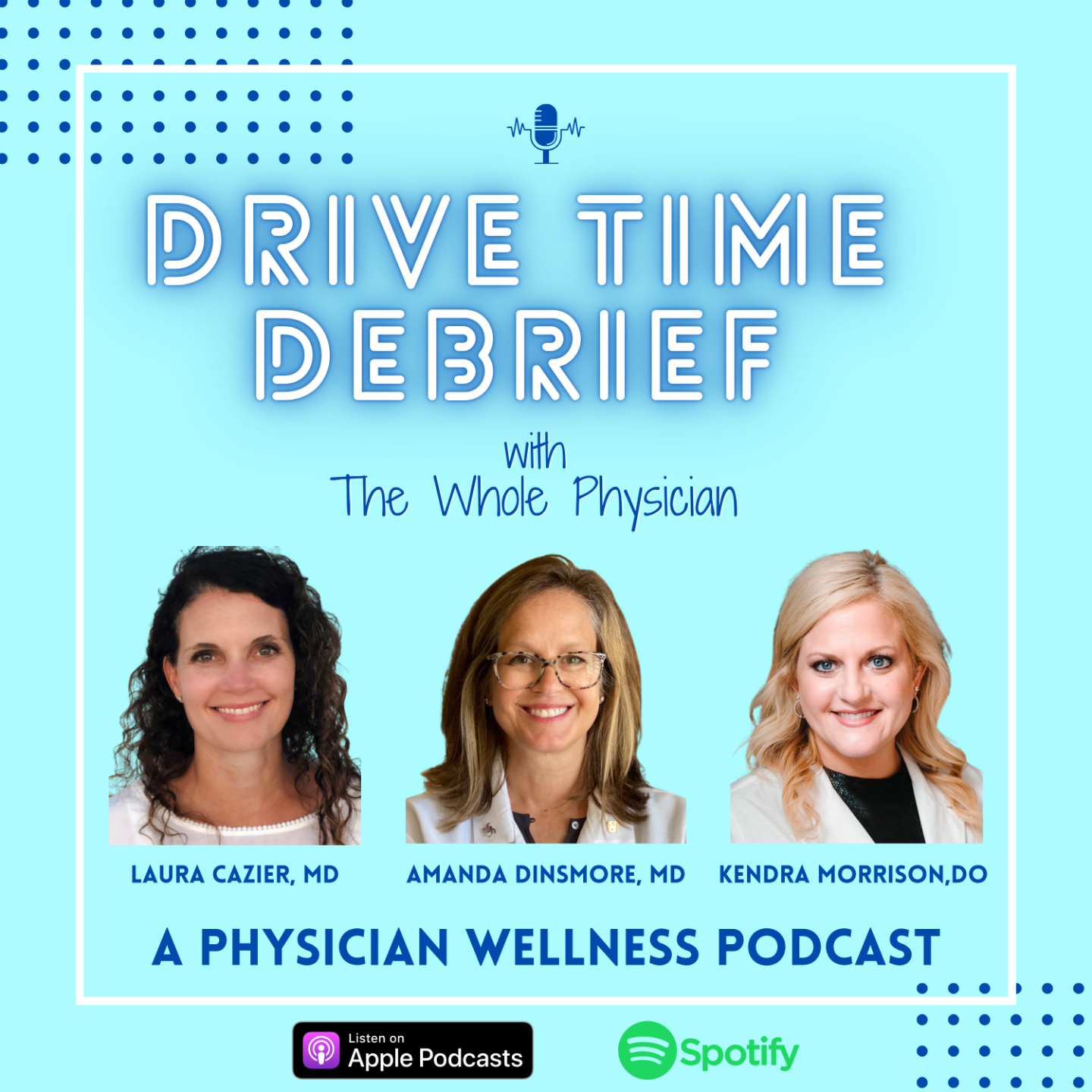
DTD 234
===
Welcome to the Drive Time Debrief with The Whole Physician, a podcast to burnout-proof your medical career with candor, humor, and encouragement. You've spent tens of thousands of hours learning how to care for others, but now it's time to learn proven tools to care for yourself. If you're tired of feeling stuck, disillusioned, and exhausted, you're in the right place.
Start your journey to bring back contentment and purpose. Now, here are your hosts, three board-certified emergency physicians, Doctors Morrison, Cazier, and Dinsmore.
Hey, guys. Welcome back to Drive Time Debrief. I'm Amanda. I'm Laura. And I'm Kendra. And today we're gonna talk about—it's not supposed to be morbid, it's actually supposed to be inspirational, but—well, let's just get into it. We're gonna talk about avoiding end-of-life regrets.
Because the beautiful thing is, if you just consider this topic, you still have time. You get a do-over tomorrow. You get a do-over for the rest of the day. And so this isn't about trying to get everybody all sad and somber. It's actually more like, "Oh, shoot, it's go time." That's hopefully gonna be the tone of this.
Imagine a physician who has a whole life scheduled in her mind for "after"—after residency, after boards, after the kids get into school, after this particular call schedule lets up. She's not unhappy exactly. It's just that she's always about to start living.
And then one day she's 59, maybe her parents are gone, her kids are grown and don't call as often, and the "after" never started. It just keeps sliding forward one delay at a time until it becomes her whole life. So here's the thing: nobody intentionally decides to defer their life. It happens through a thousand small postponements that each felt very reasonable, probably needed.
It didn't seem like a big deal in the moment. So that's why today we're gonna talk about avoiding end-of-life regrets—not in a morbid way, but in a useful way. What people actually say when they're looking back on their lives, what physicians specifically tend to defer, and two ideas you can start using today so that you're not the one saying it in 30 years.
Okay, so what do we actually regret? Let's start universal, and think about that vacation you keep saying you'll take someday. Nobody schedules someday. Someday isn't a day in your planner or on the calendar—it's a way of never actually arriving at the thing. What's interesting is that hospice caregivers, who spend their careers with people at the end of life, hear the same handful of regrets over and over.
They're not regrets about what people did—they're regrets about what they didn't do. Things like not spending more time with the people I love, not being kinder to the people I love, not being true to myself, being too afraid to express my feelings, losing touch with my friends. That's a big one, guys—especially once you get into your career, maybe you have kids.
It's so important to stay in touch with those friends, because you don't want to wind up, when your kids are all gone or when you're retired, completely friendless. And another regret was not letting themselves be happier. Notice what's not on that list. Nobody's dying wish is, "I should have taken more call," or—
I know. Shocking, right? Nobody even says, "I should have earned more money." Nobody says, "I wish I'd waited longer to call my sister back." Some of that might feel like a bit of a gut punch, because of the way we live our lives so often. But this is really good information, because we do have a substantial amount of life left, hopefully.
This tells you exactly where the risk is. The risk is not in the decisions we're making—it's in the decisions we're not making, and the time we're not spending with people we care about, and the boundaries we're not holding so that we have that space and time to do what really matters. Yeah, this is a great topic, because I think some of us, especially as physicians, defer so much delayed gratification, and I notice this coming up in myself—two things happen in my brain. One, I guess I was brought up to think I had to earn pleasure, like time away, or a vacation or something.
And maybe I did—like, I had to do chores to get a new bike or something, I don't know, I can't remember too much. But I do feel like somewhere there's a narrative that ran for a long time, that I had to earn a vacation, or work hard and then play. Maybe that was that old adage.
And then the second thing that I think really played into it was that perfectionism came out in me, so I had to have the perfect time and everything in perfect order. Like, I had to work the shifts, and it had to be the perfect week for my husband's and my schedule, the kids, school. I mean, if I waited for all those stars to align, I still would be vacationless and probably really depressed.
So I do feel like those two things—perfectionism and delayed gratification—can easily come up when we tell ourselves these stories. So I'm so glad we're talking about this, because this could be really—I know it will be inspiring to our audience to just think about the areas where that comes up and challenge it.
So where do physicians specifically defer? Let's get into the specifics here. Imagine a physician telling herself she'll reconnect with her college roommate once things calm down, right? Oh, God, when was that one? Oh, bless your heart. I say that every few months—"Oh yeah, let me get to the summer, it'll calm down."
I'm still waiting. Things don't calm down, remember? Ten years pass in a string of normal weeks, and the friendship doesn't end dramatically—it just goes quiet, and I'm sure a lot of you can relate. She notices at a reunion that she can't actually say what's new in her friend's life, and that's the cost.
It wasn't a big fallout or a fight. They didn't disagree on anything. It just slowly disappeared. And now let's imagine a physician who tells his kids, "I'll be there for the big ones—the big game, the recitals. Not necessarily the rehearsals or all the games adding up to it, but I'll be at the semifinals and the finals," right?
And he really does mean it. He wants to be there and present for the big things. But the "big ones" keep getting smaller as the kids get older, and not only do the kids kind of stop expecting him to show up, but they also kind of stop inviting him, right? Because even if it's important to them, they've heard so many times, "I can't this weekend," or, "I can't tonight, I have call, I have work, I have a case, I have whatever."
They just kind of stop inviting him. And by the time his schedule genuinely opens up, like I said, they've just stopped asking. They stopped inviting him. And now let's imagine the version of this that isn't about other people—it's about the physician himself.
He or she has been telling themselves for years, "I'll take up the thing I used to love—running, painting, guitar, hiking, canoeing, kayaking, dancing, whatever. I'm not on call so much anymore, I'm not working as much anymore. And also, I need to catch up on my wellness, my preventative health," right?
"I need a physical"—God forbid, you know, after 10 years or whatever. And the story comes up about aging parents and doing something about it, when really it's just a substitute for a phone call that never actually happens, that never gets intentionally made.
And so none of these are crises, but that's what makes them dangerous. Nothing forces a correction. This cost is kind of a quiet cost, but it accumulates in the background—that friendship, the relationship with your kids, the version of yourself that existed before the pager, the call, the career—while the calendar keeps staying full with things that are urgent. So let's start with two ideas: something about what you owe others, and an idea about what you maybe owe yourself.
Here's the obstacle with the "other people" regrets—the friends, the family, the unexpressed feelings. Your brain convinces you there will always be another chance. So when there's no deadline pressing on a phone call, it just keeps losing out to the things that do have a deadline. So one idea is: pick one relationship you've let go quiet and put it on the calendar.
Not a someday, but maybe the first step is, on your drive home, figure out one person you've been meaning to reach out to, and tonight—not tomorrow—text them before bed. Not a plan to text them—just do it. Just say something like, "I'm thinking about you. Tell me how you are." Just get the ball rolling.
And then here's the obstacle with the regrets about yourself—your own health, your own joy, your own honesty. Physicians are trained to notice what's wrong with somebody else before themselves. So self-neglect doesn't feel like neglect when you're the one doing the neglecting. It feels like discipline.
So another idea would be: treat yourself like the patient you're worried about. Would you tell a patient who hadn't seen a doctor in three years, and hadn't done anything for pure enjoyment in longer than that, "You're fine, this seems totally fine, keep going as is"?
No way. You'd be like, "My man, you only have one life, what are you doing?" You know? So maybe something you could do today would be book an appointment you've been putting off for yourself, or block 20 minutes this week for something that's just for you, with no productivity attached at all.
Here's a word for the regret you already have. Some of you listening aren't worried about future regret—you're actually already experiencing it. The friend you didn't call before it was too late, the years you spent married to the job instead of the person. You've done the math already, and you don't love the answer.
That's real, and let's talk about that. Replaying it doesn't return any of the time to you. So just sitting in the regret and thinking about it actually robs more time, and it moves that loss from something that happened once to something that keeps happening every time you re-litigate it.
You can't drive forward staring in the rearview mirror—you'll just run into what's actually in front of you. The past is one part of this that's already settled. It doesn't need more attention. It does need you to make peace with it and hand the attention over to what's still unsettled, which is today and however many days you've got after it.
Just notice the difference between remembering something and re-serving a sentence for it, or beating yourself up about it. Doctors are really good at beating ourselves up over things, and I'll offer that on the deathbed, nobody says, "I really wish I'd beaten myself up more, I really wish I let that nasty critic in my brain have more airtime," because it keeps you from living life.
So on tomorrow's commute, or the next time you designate—but designate it—ask yourself three questions. And if you're alone, you can ask them out loud. Who have I neglected? Who have I not texted, not called in a while, that I actually miss? Who are those people? My daughter recently got married, and it was so cool to have people who cared about her and cared about us come in from all over the place.
We had friends we hadn't seen in a decade come in, and it just made me so grateful to have kept in touch. Although it also made me think, "Man, I need to do better about getting together in person." But it made me so grateful that I had kept in touch with just this treasure trove of humans.
So pay attention to that. And then ask yourself, "What's the smallest, most honest action I could take to re-engage with people, or with hobbies or habits I actually really miss?" What's something you could do today to plug back into those? Just be honest with yourself—what are you going to be regretting on that deathbed if you don't take action?
Yeah, that's really good. I know we also had a personal experience with that, with my mother-in-law. She passed away a few months ago, and my daughter was debating, "Should I come home for Easter?" And she chose not to. She chose to be with some other family. And then, a month later, my mother-in-law passed away, and so I heard that regret from her too: "I should have come home, I should have come home," you know, because she was at our house, and she said, "I could have hugged her, I could have seen her one more time."
And instead of beating herself up over it, what she did was write her a letter, which I ended up reading at her memorial, her celebration of life. And I think it served a twofold purpose. It got her out of the regret—it gave no more time to the past, it silenced that regret. And then she was able to actually feel, "If I had one last conversation with her, what would I say?"
And so that whole purpose of not giving airtime to the regret, but using it as something that would actually help inspire you for the next relationship, or the next thing—like, "I'm not gonna leave..."
This drove it home for me. I'm not gonna leave the presence of the people I love and care about without hugging their neck and saying, "I love you." I want everyone to know before I leave, because you never know, right? You never know the last time. Honestly, we're not promised tomorrow, so you just never know when it could be the last time you hug their neck or tell them that you love them.
So I always try to make sure I'm never leaving, never departing—even if it's just for a day—without saying I love you, because what if it was the last time? And so that's the inspiration we hope we could plant as a seed today: the past is the past, and what's done is done.
But being able to now stay focused on, okay, where can I go from here? Worrying about it just keeps you spinning instead of calling—just do the call, do the text, just do it. Overwork keeps you tired instead of present, so we just talked about boundaries—set a tiny boundary. Silence keeps you distant instead of known—if something's bothering you, say something, right? Take advantage of the opportunity today. Deferred self-care keeps you managing everyone else's health but your own, okay?
So remembering the physician from the top of the episode, the one always about to start living—she's not a cautionary tale, she's most of us, most weeks, most months, most years. The good news is the regret hasn't happened yet, and it's not fixed. It's just sitting there in whatever you're currently calling someday. So today's the day you get to go out and do something about it. Make peace with the fact that you haven't yet, and then go do it anyway.
So that's it for today's episode, friends. If you found this conversation helpful, we wanna hear about it, and the best way to support us is to subscribe. So click the button now and leave us a rating and review, and it helps other physicians find us and moves us up on the list. And if you do leave a review, we want to see it, so take a quick screenshot and email it over to [email protected], and we will send you a free e-book on emotional regulation.
And before you go, we wanna tell you about our first exclusive physician-only wellness retreat. We are so excited about this—it's coming up, guys, November 2026, at Bodhi Tree Yoga Resort in Nosara, Costa Rica. You guys, we would love to spend a week with you in this sanctuary that is built for renewal.
It is about walking through beautiful lush gardens, hearing waterfalls. Yours truly, our amazing TWP team, will be providing some programming that'll be eligible for CME, but you'll also have plenty of time to just spend your days and afternoons in a jungle paradise. And we hope you will join us. That link is also in the show notes.
Don't wait. Grab a bestie, click the link, and sign up. And thanks for spending time with us today. Until next time, you are whole, you are a gift to medicine, and the work you do matters.
Thank you for joining us for the Drive Time Debrief. If this podcast has helped you, be sure to share it with others. Please subscribe and leave us a five-star review so other doctors can find us. If you want to know more about what we do or work with us, go to our website at thewholephysician.com and schedule a free 30-minute strategy session.
We'd love to help you create the life you dreamed of before things went awry. It's absolutely possible.