# DTD 206
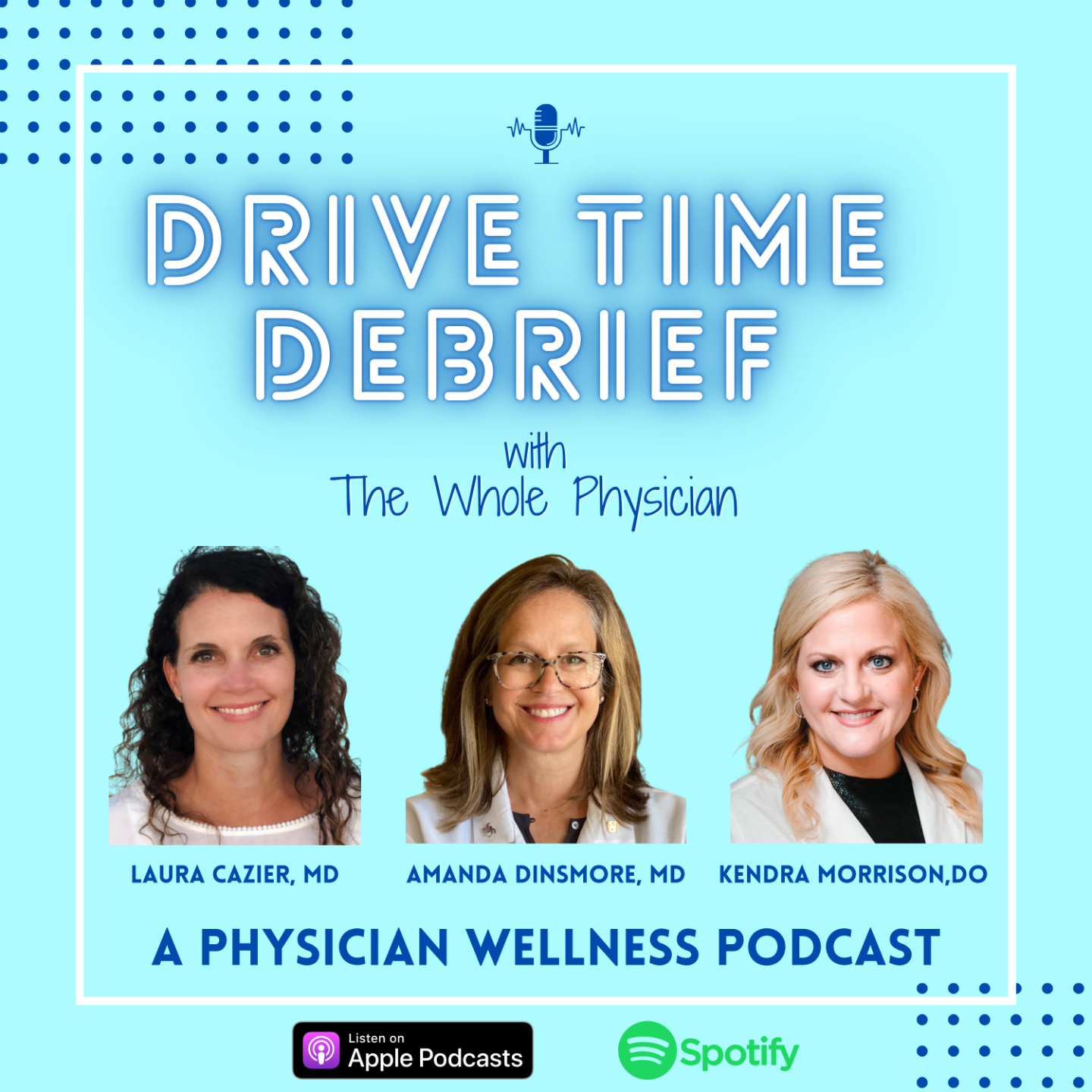
[00:00:00] This is the Drive Time Debrief, episode 206.
Hey guys, welcome back to the podcast. I'm Amanda. I'm Laura. And I'm Kendra and I cannot believe that I forgot to mention this, but I just wanted to celebrate and thank everybody who voted because our podcast, the Drive Time Debrief that you're listening to right now won the Best Physician Wellness and [00:01:00] Burnout podcast award. That was at the 2026 Doctor Podcast Awards at PodMatch back in January. So thank you. That is such a—yay us. Thank you so much. Woo. Yes. Thank you guys. We feel so—today. I can't. I'm so excited. It's so cool. We're coming up on our, is it our third birthday or fourth birthday in March? I can't. Fourth birthday. Fourth birthday, no. Or four years old. Boom. Yay.
Okay, so today let's talk about how a physician's helper identity can quietly fuel burnout. So if you're a physician, you likely went into medicine because you genuinely, at the deepest level of your soul wanted to help people. But today we're talking about something that looks noble on the surface, totally gets praised and reinforced in medicine, and yet quietly drains [00:02:00] so many physicians—drive our identity as the helper. Being a helper isn't the problem. It's over-identifying as the helper and never choosing when or how you help. It's always just a yes.
So how is this helper identity formed? Most physicians didn't accidentally become helpers. I feel like there's a special altruistic, smart, intelligent doer that is attracted to medicine. So we kind of self-select in the first place, and then we get into medical training. And guess what? We're rewarded for being reliable, saying yes, saying yes more than anyone else, putting everyone else's needs first. Definitely don't go to the bathroom even in the middle of your rounding or shift or whatever it is. Helping somebody else's emergency becomes greater than our own basic needs. We become proud of how much we don't need others, how independent we are, being able to be that grinder, the one that pushes through, the one that stays late and doesn't complain.
I was in a book club. Some were doctors, some were not. And we were telling the story of how cool our colleague was because he had literally passed out from dehydration at work. But he kept seeing patients 'cause we hooked him up to an IV and like "How cool." And the non-physician people in the book club were horrified. And seeing the look on their face, I was like, "Wait [00:03:00] a sec. It was the first time I ever was like, maybe, wait, maybe that's not good." The crazy things we brag about. I know. Yeah. But literally I thought it was the coolest story as I was telling it, and then was like, "Oh, probably that person shouldn't be seeing patients." Right. If they're passing out from dehydration. Anyway, so medical school and residency programs looked like that. Passing out in the bathroom, dehydrated and hooking yourself up to an IV and continuing to power on—self-sacrifice is normalized, endurance is praised and needs truly are seen as weakness. Someone literally might tell you that.
So clinical example number one, the "I'll just stay longer." Imagine you're at the end of your brutal shift and you've already given sign out and someone says, "Hey, can you see one more patient?" And instead of checking in with yourself, instead of taking that pause, you just hear yourself reflexively say, "Sure, absolutely. Happy. Happy to do it." Not because you want to, but because disappointing the team feels worse than being exhausted. That's not [00:04:00] generosity, that's conditioning.
So when we talk about the helper identity, this pairs well, right? We're talking about four course meals here. This pairs well with people pleasing and fear of disappointment. These are the two entrées served up nicely with the helper identity. And basically what happens is because we have the fear of disappointing others, right? Remember, we're gold star getters and the unfortunate thing is not the part that we love to get gold stars because we try hard, we give effort. That's not a bad thing. The problem is the underlying motivation is fear of disappointment, and it probably started well beyond the time we got into med school or college even. Right. It usually starts somewhere in that development phase in our family of origin where maybe you didn't wanna let your parents down or a teacher down or a friend down, and that seed that got planted there unfortunately now gets watered into full blown people pleasing by the time you're in med school and residency.
A lot of physicians are also afraid of being difficult, right? [00:05:00] We've heard of like being the team player—we've talked about this before, that self-sacrifice almost to a detriment because you're not taking care of yourself. And if you think about that, being the team player, the best case scenario is that you are rested and fed and watered and all that so you can show up and really give your all for the team. Not that you would say no because you're protecting time, energy, or focus, but instead being seen as difficult because you're not willing to do those things. And that more or less leads to further exhaustion and really can breed a lot of resentment.
And I know I had this, this is my testimony, I wanted to really cover, you know, if someone had an emergency or couldn't show up for a shift, despite the fact that I just came off three nights, I was like, "Oh yeah, I can pick that up. I can pick that up." It probably wasn't the best choice, but it was like we can't have a hole in this schedule and I'm not sure who assigned me as the hole filler—myself—and just willing to pick up whatever shift needed to be [00:06:00] covered at a detriment though 'cause I did not show up as a wife or mom or anybody else that I wanted to be after doing that. And you know, really being able to take a pause before saying yes. I think this is a big gut check for physicians. We don't really get in touch with how we're feeling because you know, we're cut off at the neck. Like we are so cerebral and we're so in touch with our cognitive ability that we forget to check in with our bodies or ourselves, our emotions, our whatever that we're feeling. We've ignored that all day or all week. And so we just say yes out of that people pleasing and fear of disappointment or letting people down and we forget to check in with ourselves.
And the part about that emotional labor, so where I went wrong was picking up the shift and then adding a layer of stress because then when my kids were young, who's picking them up from this school, that practice, right? That was all on me. So then I added another layer of stress. I'm working an extra shift, [00:07:00] and now I gotta figure out all the details around who's getting what, where, how are kids getting picked up, et cetera, et cetera. It's not just saying yes out of reactance or not taking that pause.
So here's the good doctor trap, right? Let me paint a picture. You're post nights, right? So if you're either on call or nocturnist or you're ER working some night shifts, you're delirious and absolutely cortisol fried. And then your last patient of the morning right before you get off, asks for something non-urgent, non-medical and really actually completely unreasonable. And instead of setting that boundary, you comply. Why? Because they're having a hard time. You can make up any excuse you want. "Oh, they're having a hard time. I feel bad for them. Oh, it's just one more thing. I can do it. It's easier if I do it myself," right? I told myself that a lot, right? "It's all on me. I'm the one that can take care of it the best or the easiest," whatever it was. But it's really not that you're bad at boundaries. You're just excellent at helping. And [00:08:00] unfortunately, society and other people take advantage of that.
And why do we over-function? This also plays a role into our helper identity. We do way more than our fair share, and it's not even really about fair. It's just more than our share, more than what we really are required to show up and do. We're constantly fixing. We're constantly rescuing. We're constantly smoothing things over. It's that whole walking into a room and that intuition tells you, "We're walking on eggshells," right? The people are delicate. The patients are delicate, the people you work with, you're just constantly being that person that smooths things over because you can anticipate before anyone asks. "I can read a room. I know when I walk in and there is tension. It's thick," right? I mean, you can cut it with a knife sometimes, and I anticipate that, and then I'm working extra hard to smooth it over, whether they were just rude to my nurse or whatever it is. You anticipate, and then you're working really, really hard to make everybody feel good, feel better, work better, whatever it is.
And so when you do that, when you cover gaps that aren't yours to cover, when you're fixing the system problems individually, right? 'Cause who nominated us to fix our whole healthcare problems? I don't know—no one that I know of. But you absorb a whole bunch of emotional chaos and that is just too much. It was not yours to carry. And that doesn't actually help what you're intending to show up and help. And so while that can be a load at work, at home, it's the same. You carry that emotional and mental load. It's the same. You can walk into a tense situation. Anybody have a house full of teenagers like I do? Like it could be tension in like zero to 60 flat. You're just like, "Whoa, what just happened? Like who turned the thermostat? Like what just happened?" But over time, if you're that person that continually is analyzing, fixing, smoothing, over-resolving, showing up, this [00:10:00] is gonna create a quiet resentment. It's gonna make you emotionally exhausted and it is quietly leading to burnout. It is a major player, an underlying quiet factor that leads to burnout.
It's kind of like that feeling that you tell yourself, "I give and give and give all the time, and nothing ever fills me back up." So if you're the emotional support doctor that I just described, you're not just treating chest pain, diabetes, and everybody else's mental health issues. You're also managing the family's anxiety, buffering staff conflict, apologizing for boarding, the waiting room, throughput, taking all of this responsibility on yourself, that is completely outside of your control. No wonder you're tired. No wonder you are totally fried and no wonder you can't even see straight. Sometimes you're doing some unpaid emotional labor on top of the clinical medicine that you strive to give every single day.
I had a couple of thoughts while [00:11:00] you were saying those things too. Just a couple of other unintended consequences of this over-functioning. One is that when we're trying to not be difficult by having reasonable expectations for sleep, food, bathroom breaks, sanity, we are propping up a system that is unsustainable for the people who come behind us. So this is why like the stories of the doctor who passes out and then gets an IV put in and keeps seeing patients make me cringe so much because in no way, shape, or form should that be normalized. Like that is, that's just not healthy for anyone involved. So that's one thing, and then the other thing I have is that sometimes what we don't realize we're doing when we're over-functioning is we're actually, especially in family systems, when we are over-functioning, we are [00:12:00] inhibiting the development of other people. We are making the assumption that they are not capable of doing whatever it is we are doing for them and we're allowing their underfunctioning and allowing their underdevelopment. And so it's not, you know, it's not actually kind or good at all that we're doing it. We're doing it out of our own anxiety so many times, and it makes sense and it can help break that cycle for us if we realize, "Hey, it's actually not as kind as I—I'm not actually being as kind as I think I am. What I'm doing is actually not as noble as I like to think it is." So maybe that will help you break that cycle if you are identifying as one of these helper overfunctioners.
And why do we talk about all this? Burnout is our primary focus and preventing it, and so we're gonna talk about why all of this leads to burnout. Even when you love medicine, [00:13:00] most of the time burnout isn't about hating your job. So much of the time it's about all this craziness that we pile on top of it, and a bunch of stories we make up about it. A lot of times it's about not taking care of ourselves, not choosing our needs, and making sure they get taken care of, not having agency. And we don't always have control over that in a work situation. But when we're not advocating for our own agency or our ability to choose, ability to practice the way we feel is most fit, it really can drain our energy and when we're living in constant self-abandonment—and self-abandonment is exactly what has been described, where we are doing things that we know are not in our own best interest because of X, Y, Z, not because somebody's life is on the line and we need to save them, because we don't wanna inconvenience other people or because we don't wanna seem difficult. That's not, [00:14:00] that's not noble. That is probably a survival strategy we learned in childhood that is not serving us now.
When helping becomes automatic instead of intentional, if we have an automatic "yes" before the request has even had time to process in our brains, we know that we are not acting in alignment. We're acting out of a desire to please other people. We're acting out of a desire to remain socially acceptable and not be rejected and not face shame or being outcast, not being labeled the difficult one. So it is so important for us to be intentional and know what our values are and act in alignment with them. Because if we don't, it is gonna cost us our health. It's gonna cost us our peace and our relationships. And like, not to be dramatic, honestly, it can cost us our lives if we do not get this straight for ourselves. This is where chronic disease often shows up. Autoimmunity. Oh my word. I don't know [00:15:00] how many, how many studies have been done on this. I'd be curious to look, but autoimmunity I am fairly certain has a tie to this self-abandonment, crashing in the dark 'cause you're exhausted. Yeah, absolutely. It literally, and our brains are telling our bodies what to do. If you're abandoning yourself, then your body will start attacking you too.
So we can reframe from "I must help," or "I'm the one who fixes everything" to "I can help," or "I choose where I help. I choose wisely where I help." The goal is not to stop caring, and the shift is moving from obligation or like the survival instinct honestly, to, "I'm gonna choose intentionally. Is this good for me? Is this good for my family? Is this good for the system at large?" Going from a reflex of yes to an intentional yes.
So a values aligned helper looks like this. They know their limits. They [00:16:00] choose where their energy goes and they help without abandoning themselves. They are not gonna pick up work after having worked three nights in a row when they know that they're exhausted. They're not going to agree to do something on a night when they've already promised to take care of themselves or to spend time with loved ones. They are gonna choose. Notice their energy. It is very clear. It's so interesting when you pay attention, you can tell what gives you energy and what drains it. I was just talking to a client earlier today. He was like, "You know, I love my work and these meetings drain me." I'm like, "There, you do not have to go to all the meetings. You do not have to go to all the meetings." Choose where your energy goes. Help without abandoning yourself. This doesn't mean you don't ever help. Just make sure you're not abandoning yourself when you do help.
And then don't confuse self-sacrifice with professionalism. I'm not saying there's [00:17:00] never a role for self-sacrifice, but self-sacrifice as a way of living is a fool's errand. It is not good for you. And believe it or not, it is not good for other people. It's not a good way to model how to live for your trainees or your kids if you have them. Being conscientious and choosing wisely about where you sacrifice. Make sure it's meaningful, make sure it's aligned with your values, and actually it's not gonna drain you beyond what you can refill quickly. That is the key. And if you think of someone who is completely professional, they are not walking around seeing patients with an IV in their arm, and as brave as that was, I would just argue it's not, it's not sustainable for everyone and it's not professional, so make sure that your sacrifices still align with your professional identity.
So there's some micro shifts that we can [00:18:00] make. Before you say yes, ask, "Do I want to do this or am I trying to avoid discomfort? Am I feeling anxious because I don't want to feel disapproved of by saying no? I don't wanna be disliked." That's an important piece of information. Discomfort, really, discomfort can become your friend. When we are able to embrace discomfort, we can get to the things that we want in life. That discomfort is not danger. And for other people being disappointed in us, that does not indicate a moral failure on our part.
Just consider this. Where in your life are you operating from a helper identity instead of a values-based choice? And what I mean by that is where are you trying to make other people see you in a certain way when you are taking on these helping scenarios? Not because you really want to, but [00:19:00] because you want to avoid being disliked. What is one small shift you could make this week? One place you say, "No," pause, "I need, let me get back to you. I need to check my calendar" and choose differently to help in a way that actually aligns with who you want to be.
Helping is powerful and we are in a helping profession and we value helping, but it's only helpful. It's only powerful when it doesn't cost you yourself, your wellbeing, and ultimately your career if you allow this to burn you out. If you allow this to go on and you burn out, you can cost yourself your career. You can be a deeply caring physician without setting yourself on fire to keep whatever situation, whatever dumpster fire you are working in—you don't have to contribute to that to help keep it running. You don't need a fire for people to be warm. It's okay to step out [00:20:00] and say, "How do I really wanna show up here? How do I really want to help in a way that's healthy?" And move forward according to that information.
Yeah, such a great conversation and just an awareness because like I said, we were made as helpers. I think medicine as a whole really attracts people who love to help. It is that altruism, it's that drive that I think really chooses us just as much as we choose medicine. And so don't get us wrong here, we are helpers. But there is a way to do it that is sustainable and that actually protects you in the long run to have longevity in this career. We need great doctors, great NPs, great nurses, great everyone in healthcare because all of us together as a team make a real difference. But that is, if we're all showing up, well fed, well watered, well-rested, all the things ready to help and ready to give our [00:21:00] all.
So thank you for joining us today, friends, and if you found this conversation helpful, the best way to support us is to subscribe. So go ahead and click that button now and leave us a rating and a review because it helps other physicians find this podcast and it moves us up on the list.
And before we go, we just wanna invite you to something we're super excited about and this is our first exclusive physician only wellness retreat. We are doing a collab with MedTreks International for a lush physician retreat at Bodhi Tree Yoga Resort in Nosara, Costa Rica. So join us this November. This place is amazing. It is a sanctuary built for renewal. You are going to love this place. It is designed to restore vitality, reclaim joy, and walk away with some sustainable tools. We'll be there to deliver all the [00:22:00] awesome content, but there'll be plenty of time for you to enjoy this place, this amazing tropical paradise, and spend your days immersing in all kinds of restorative activities.
And why we wanna let you in on a secret is for February, we are running a discount code. We'll provide the link in the show notes. But if you check out, if you act now and check out today, use coupon code RESTORE26 R-E-S-T-O-R-E 26 at checkout and you can get a discount and it's only for February. So act fast.
Thanks for spending time with us today and until next time, you are whole. You are a gift to medicine and the work you do matters.
[00:23:00]