Are You "Shoulding" on Yourself?
May 29, 2025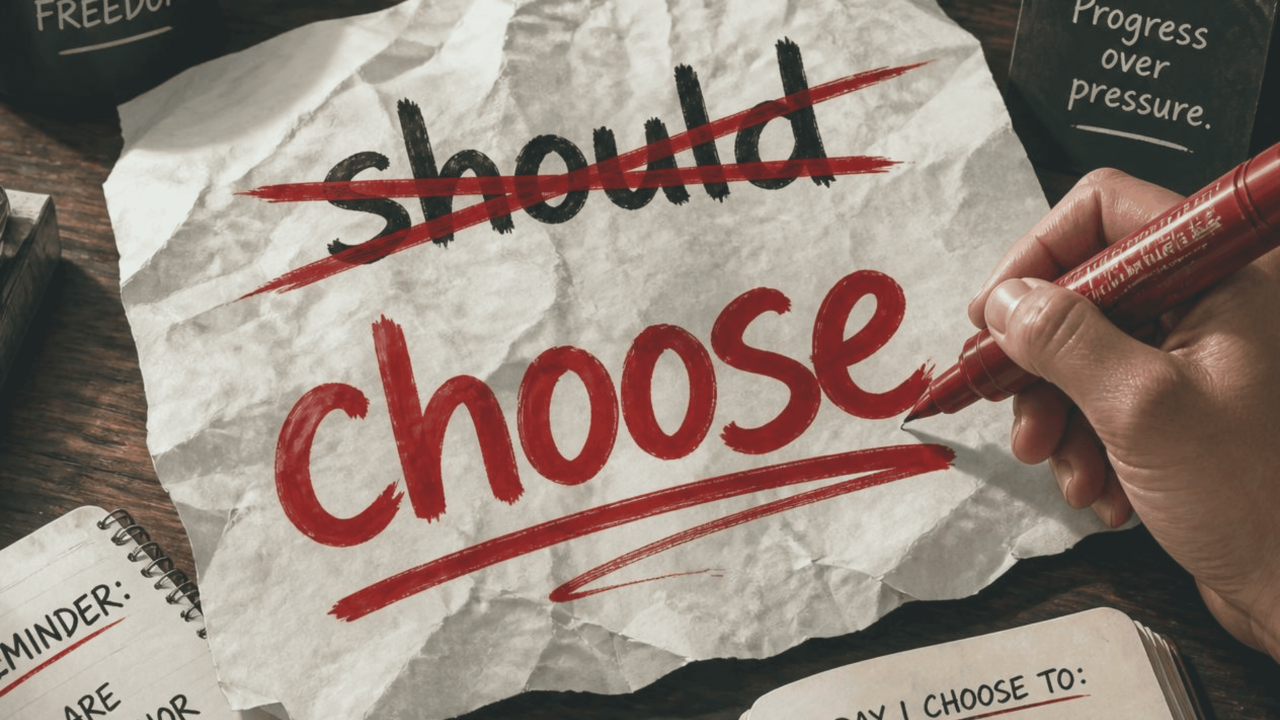
"I should have caught that diagnosis." "I should stay late." "I should be more productive." At first glance, the word "should" sounds responsible, even admirable. Author Marshall Rosenberg, in his work on Nonviolent Communication, makes a striking claim: "should" is actually a violent word, not dramatically, but in the specific sense that it imposes an external, often unexamined demand rather than reflecting a genuine, considered choice.
Why "Should" Is a Problem
Every time "should" gets applied internally, it reinforces a specific cluster of experiences: shame, guilt, internal pressure, and a sense of external authority, even when no actual outside voice is issuing the demand. "Should" frequently functions as the inner critic speaking, a voice attempting to enforce safety and standards but ultimately keeping the person stuck rather than genuinely served. In the framework popularized by neuroscientist Dr. Jill Bolte Taylor, this voice corresponds to a left-brain-dominant mode of operating, task-focused, rule-driven, and largely disconnected from a more spacious, present alternative.
Left unexamined, this pattern becomes fertile ground for burnout, chronic overwork, self-sabotage, resentment, and a genuine loss of joy, presence, and meaning in the work itself.
A Three-Step Reframe
Catch the "should." Awareness is the necessary first step, noticing the specific moment "should" shows up internally is the cue to actually examine it.
Ask what need is actually being addressed. Rosenberg's broader framework includes an inventory of underlying human needs, connection, belonging, rest, competence, meaning. Identifying which specific need is actually at play behind a given "should" clarifies what's really driving the thought.
Reframe it explicitly as a choice. "I should stay late" becomes either "I choose to stay late because I value supporting my team" or "I'm going home on time because I value rest and family connection." Either direction removes the shame and guilt, replacing it with an actual, examined alignment between values and action.
A Few Examples
- "I should be more productive" becomes "I want to be efficient because I value purpose and growth."
- "I should go to that meeting" becomes "I'm choosing to go because I want to contribute."
- "I should pick up that shift" becomes "I'm choosing not to, because I need rest right now."
What Reclaiming Choice Actually Does
Shifting from "should" to genuine choice moves the underlying experience out of survival mode and into something more deliberate and sustainable. It supports reconnecting with the actual reason the work matters in the first place, and it means living in alignment with genuinely held values, rather than an externally imposed, or self-imposed but unexamined, set of expectations.
Practical Ways to Start
A few concrete starting points: write down the five most frequent "shoulds" currently running in the background. Practice the three-step reframe directly on each one. Pay attention to how "should" physically registers in the body, tension, tightness, a specific felt sense, as a way of building faster recognition going forward. And consider a simple mental shift: "I release should. I choose."
The Bottom Line
"Should" feels responsible, but it frequently functions as an unexamined source of shame and pressure rather than genuine motivation. Catching it, identifying the actual underlying need, and reframing it explicitly as a choice offers a real, practical path toward acting from genuine values rather than internalized obligation.
FAQ
Why does Marshall Rosenberg describe "should" as a "violent" word? In Nonviolent Communication, "should" represents an external, imposed demand rather than a genuinely examined choice, even when self-directed, it functions similarly to an outside authority dictating behavior, rather than reflecting authentic values.
How can identifying an underlying need help with "should" statements? Recognizing the actual need behind a "should", connection, rest, competence, meaning, clarifies what's genuinely being sought, making it possible to address that need directly rather than defaulting to an unexamined obligation.
Does reframing "should" as a choice change the actual outcome or behavior? Not necessarily the behavior itself, the same action might still occur, but the internal experience shifts significantly, from shame-driven obligation to a genuinely examined, values-aligned decision.
What's a practical way to start noticing "should" statements in daily life? Paying attention to how the word physically registers, a tightening, a specific felt sense of pressure, helps build faster recognition of the pattern as it arises, making it easier to pause and apply the reframe in the moment.